By Luke Hunter
Correspondent
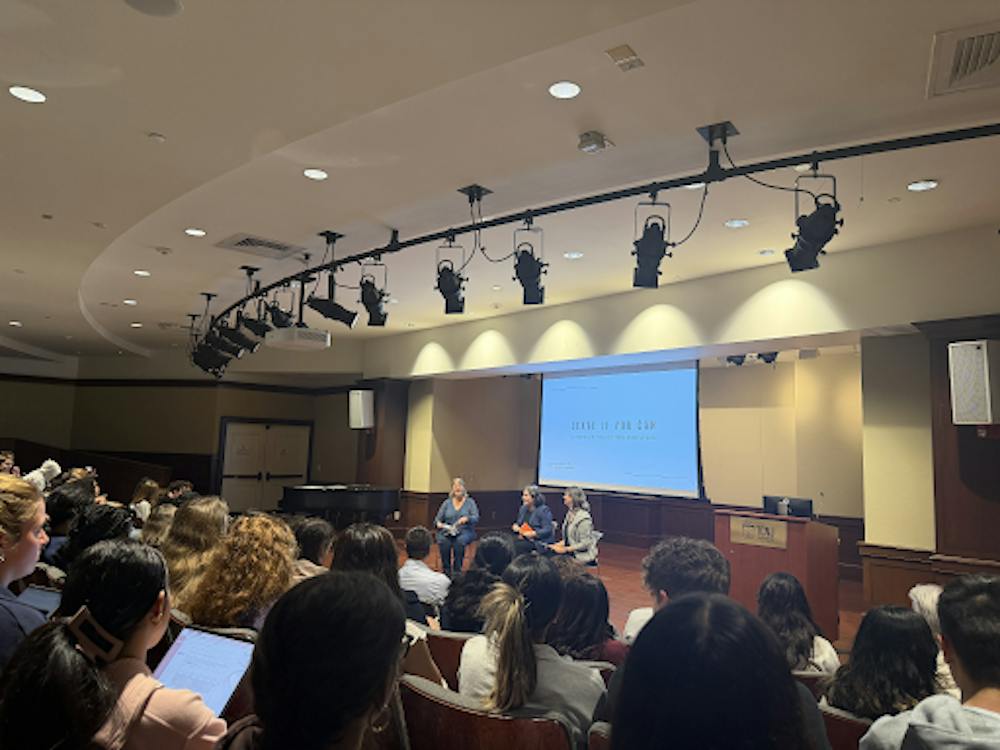
Amelia Frank-Vitale, assistant professor of anthropology and international affairs at Princeton University, visited campus on Sept. 30. She spoke to a crowd of students and faculty about her new book “Leave if You Can: Migration and Violence in Bordered Worlds.”
Frank-Vitale addressed the crowd at the College’s R. Barbara Gitenstein Library Auditorium in an event sponsored by the School of Humanities and Social Sciences and the Women in Learning and Leadership Program.
Frank-Vitale began her presentation by explaining the nature of the research she conducted over the past 10 years, stating, “My book draws mostly from ethnographic field work I conducted across more than a decade in Honduras and Mexico.”
Frank-Vitale explained that she views the field of anthropology as “the attempt we make to get as close as possible to everyday life, and in so doing, learn the patterns and processes, the unspoken, taken for granted things, cultivating serendipity, being present and furious with enough consistency and depth to be there when the accumulation of everyday life teaches you something.”
Pulling from stories she collected of ordinary people in Mexico and Honduras, Frank-Vitale introduced the audience to Kevin, a Honduran man who in her words, “leaves again.” “As many times as Kevin is deported, he will keep leaving Honduras. Not because life feels unfamiliar to him there, but because he knows it all too well.”
Kevin’s story is not a unique one, Frank-Vitale explained. She informed the audience that Honduras, a nation of 9 million people, saw 600,000 of its people deported back to Honduras from the United States between 2014 and 2024.
Frank-Vitale concluded the lecturing portion of her visit by drawing a parallel between the gangs and their fight over territory in a Honduran neighborhood like Kevin’s, as well as nation-states which fight with the same ferocity to maintain their territory and borders.
After inviting questions from the audience, one member asked the author about her experiences attempting to “rehumanize” countries which have often been thought of only because of their harrowing statistics. Frank-Vitale connected her time in Honduras to her experience growing up in the city of Reading, PA. According to Frank-Vitale, Reading is a city which at the time was known for crime. She explained how she was interested in “talking with young people who live in the midst of a place that has the title of highest murder rate in the world, and kind of getting the sense of how they live, what they think about their neighborhoods and their communities.”
Another audience member asked Frank-Vitale to comment on El Salvador’s current President Nayib Bukele, a president who, despite having swept away democratic principles, remains extremely popular, according to Directio Legislativo. El Salvador is a country that neighbors Honduras, and has previously been plagued with similar kinds of gang violence. Frank-Vitale explained this popularity by saying “a lot of people would rather have security than democracy.”
Frank-Vitale further explained that attempts were made unsuccessfully in Honduras to mimic the policies of President Bukele. She attributes the failure of these attempts to the large number of gangs in Honduras and the sheer amount of drug capital that flows through the country. She also noted, that unlike El Salvador, “Honduras is a major point of drug shipment towards the United States. It is the connecting point between Venezuela, Colombia and Mexico.”
The professor ended her remarks by speaking to the diverse experience immigrants have within the United States. “Some people fled gangs in Honduras and are targeted by gangs in the United States. Some people are shocked by their racism in the United States. Some people don't experience it as particularly a problem,” she said.
Students within the audience walked away from the presentation with new insights.
Hannah Chahine, a freshman biology major, said, “This talk made me think about living through these people’s shoes. I wasn’t just able to think about the dangers of these countries but the people there. There are kids who are just my age, and even younger, who have big dreams but have no choice but to live the life they were brought into.”
Chahine attended the presentation for the Women in Learning and Leadership program. “In WILL, we study how intersectionality and your identity can influence your life,” she said. “Hearing how people’s immigration status can impact the type of life they have has made me recognize how diverse everyone’s experiences and journeys are.”
“One thing I took away from the conversation was that we shouldn't focus only on a narrative of suffering and violence because that limited perspective can be dehumanizing,” said Julia Speer, a junior urban elementary education and Spanish major. “Dr. Frank-Vitale tries instead to paint an image of real, complex people dealing with an impossible situation and hoping things could maybe get better.”
So long as the movements of people from lands foreign and familiar continually causes strife, in Frank-Vitale’s words, “borders are at once a space of division and space of connection.”