
By Owen Jacobs
Correspondent
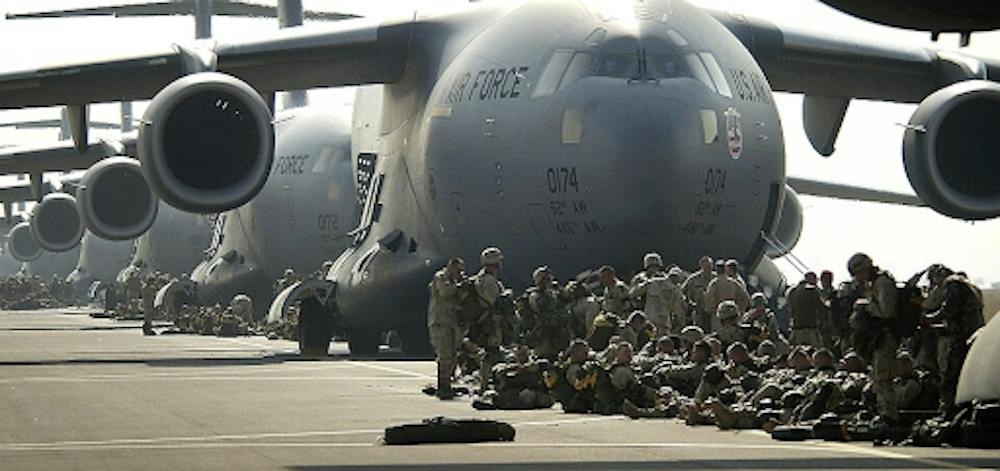
The U.S. military withdrew forces from Iraq, according to NPR, marking the end of a 12-year campaign against the Islamic State. The last troops left the Erbil Air Base, the center of U.S. ground support in Iraq, on Wednesday, Sept. 30.
The campaign followed the initial Iraq War, a conflict that began in 2003 with the infamous phrase “shock and awe” as a mission to overthrow former president of Iraq Saddam Hussein. The Bush Administration claimed that Hussein’s government was developing weapons, a claim since then disproven, according to the The New York Times.
The war became a convoluted power struggle that lasted until 2011, five years after Hussein was captured and executed. All told, hundreds of thousands of Iraqi civilians were killed and a civil war consumed the country, according to The Guardian.
The nature of the conflict changed in 2014 when IS militants captured large areas across Iraq and Syria, including Mosul, according to PBS News. The Iraqi government then invited U.S. forces to return in order to fight the Islamic State and train the Iraqi military alongside a coalition of more than 80 countries.
The U.S. has maintained a troop presence of roughly 2,500 in Iraq since 2021, CNN reported.
In an announcement posted on X, U.S. Central Command called the recent withdrawal of troops “part of a planned transition to a U.S.-Iraq bilateral defense relationship,” asserting that “ISIS no longer poses a systemic threat.”
With the Islamic State now largely reduced to sleeper cells, the U.S. will focus on intelligence support while respecting Iraqi sovereignty, according to AP News.
This troop withdrawal, agreed upon two years ago by Washington and Baghdad, is part of a larger shift in U.S. foreign policy rhetoric toward Asia. Even so, the U.S. is embroiled in a bitter conflict with Iran that began in February – a struggle that has cost the U.S. upwards of $43 billion so far, according to The New York Times.
Concerning the withdrawal, President Trump said in a social media statement on Sep. 30 that IS “has been completely decimated by the Trump Administration.” Trump also proclaimed that the past 12 years were spent successfully fighting an Iraqi caliphate and praised Iraqi Prime Minister Ali Al-Zaidi.
Reactions to the end of U.S. military intervention in Iraq are mixed. The New York Times reported that many Iraqis are speculating on where this may leave the country, while officials of the semi-autonomous region of Kurdistan expressed not only their fear of renewed attacks from the Islamic State but also concerns regarding potential Iranian aggression.
The Kurdish region, caught in the crosshairs of the U.S.-Iran war, relies on U.S. air defense systems for security, according to AP News. Along with air support, the U.S. provides signal intelligence and surveillance assistance to Iraqi and Kurdish forces, according to NPR.