By Sky Pinkett
Features Editor
For most students at the College, winter break is a time to rest, rejuvenate and reflect on what we’d like to improve on in the upcoming semester. For others, such as the student members of the College’s very own Humanitarian Engineering club, winter break became a time of giving back to the community.
“We’re a service engineering based club that helps do things that better our environment,” Terrell Osei-Kyei, Humanitarian Engineering's president told The Signal. “We do cleanups throughout the year and we do service projects.”
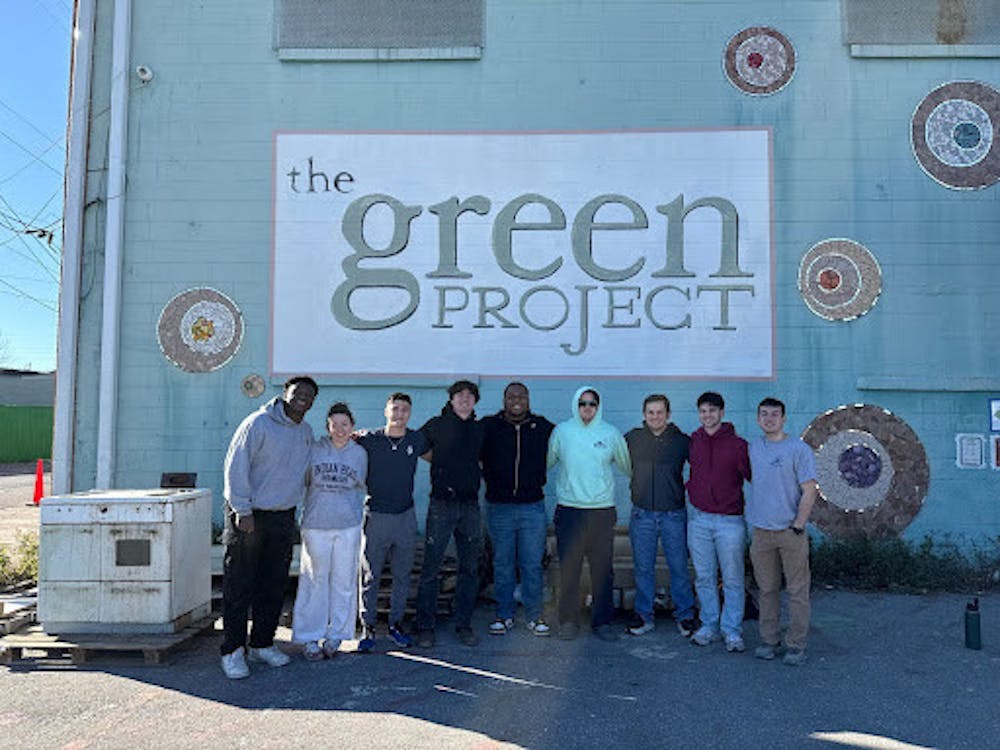
From Jan. 14-18, nine Humanitarian Engineering members took a trip to New Orleans to participate in efforts to creatively recycle materials.
“This [trip] was about recycling and reusing materials, so we helped with that for three days this year,” Osei-Kyei, a senior civil engineering major said. “People would send in their trash to the Green Project and we would try to figure out ways to restore and reuse it. A lot of the work we did was working with paint. They take paint and find a way to recycle it or reuse it. We would first figure out if the paint was usable and if it wasn’t we would recycle it and put it in this wood chipper.”
Humanitarian Engineering has a history of taking trips to better the environment within the state, nationally and even internationally. This recognized student organization, which is open to both engineering majors and non-engineering majors, has previously gone to New Orleans in partnership with Rebuilding Together New Orleans to assist in building a community garden, and has traveled to Thailand to help build a water treatment system.
“It was pre-COVID that we would do annual trips, and we just started it up again last year. We’re definitely looking to go back next year,” said Jaclyn Ladas, a junior biomedical engineering major and Humanitarian Engineering’s upcoming president.
This year's trip saw the club partnering with The Green Project, a New Orleans-based organization whose mission is to “promote a culture of creative reuse by diverting usable materials from landfills and cultivating a respect for their value.”
“The Green Project began as a volunteer Paint Recycling Program in 1994 when it became clear that New Orleans needed a responsible alternative to dumping paint polluting regional waterways,” Erin Genrich, The Green Project’s program manager for environmental education and outreach, told the Signal. “With equity in mind, our founding members sought to recycle usable paint and resell it to the community at an affordable price…We extend our work into the community through a free K-12 Environmental Education program.”
The Green Project and Humanitarian Engineering used those four days over winter break to establish “plant recycling programs, storefronts and environmental education programs” for the New Orleans area.
“A cool thing about it is the paint that we would recycle would go to the city for children because it was basically for education. It’s cheaper for them to get the paint through The Green Project, and so it would help support inner-city kids in New Orleans with paint recycling.” Osei-Kyei said.
Funding for this altruistic venture was made possible by the RSO’s fundraising efforts, as well as the Student Finance Board and the Dean of the School of Engineering.
“The School of Engineering happily supports interdisciplinary clubs like Humanitarian Engineering,” Dean Andrea Welker of the School of Engineering said. “I want to recognize the effort the students put into fundraising to support their travel.”
Humanitarian Engineering also felt the full support of the College’s Center for Community Engagement, as staff member Katherine Sheridan told the Signal, "The Center for Community Engagement was proud to support the Humanitarian Engineering Club's service trip. They utilized our TCNJ Service Mini-Grant funding opportunity, which provides awards for student-led service activities of up to $1,000 per event.”
The effort put into making this trip possible paid off in the academic and humanitarian impacts it left upon students and the New Orleans area as a whole.
“Going to NOLA was truly a life changing experience for me,” said Christian Ambio, a senior mechanical engineering major who attended the trip. “I felt that for the first time my community service efforts made a difference. I grew a new appreciation for seeing positive effects of a good group of people, doing great things, for an even better cause.”
Genrich explained that The Green Project is used to collaborating with colleges and universities on a local and international scale. “TCNJ just reached out with interest via email and we were happy to host them.”
“The volunteers helped us tremendously by sorting various hardware materials and water-based house paint, and helped us also process waste paint - an activity that requires adding sawdust to bad paint and mixing,” Genrich said.
The members of Humanitarian Engineering who took part in this trip also derived great academic benefit from it, they told The Signal. In addition to feeling proud at their work in helping communities in need, the students said they enjoyed the larger imprint this trip would leave on their academic work and future career goals.
“These students take what they have learned in class and apply it to solve problems to improve the quality of life of the communities they serve,” Welker said. “These trips provide real world and immediate proof of the ability of engineers to make the world a better place.”
“It’s definitely nice to see the humanitarian aspect of [engineering],” Ladas said. “I think a lot of it has to do with the help that we can do for the environment, especially surrounding natural disasters like Katrina when we went down and helped…I loved helping a community besides ours.”
The future of engineering is looking bright with the existence of clubs like Humanitarian Engineering, especially as it pertains to the declining state of the world's natural environments.
“I didn’t get into engineering because I wanted money. Money is nice and everything but I wanted to help design solutions for the environment,” Osei-Kyei said. “I feel like the climate crisis is a pressing issue and we need to start thinking of ways to design systems that will last longer.”