By Devyn Briones
Arts & Entertainment Editor
Clothing carries memories, preserves stories and speaks for those who feel mute.
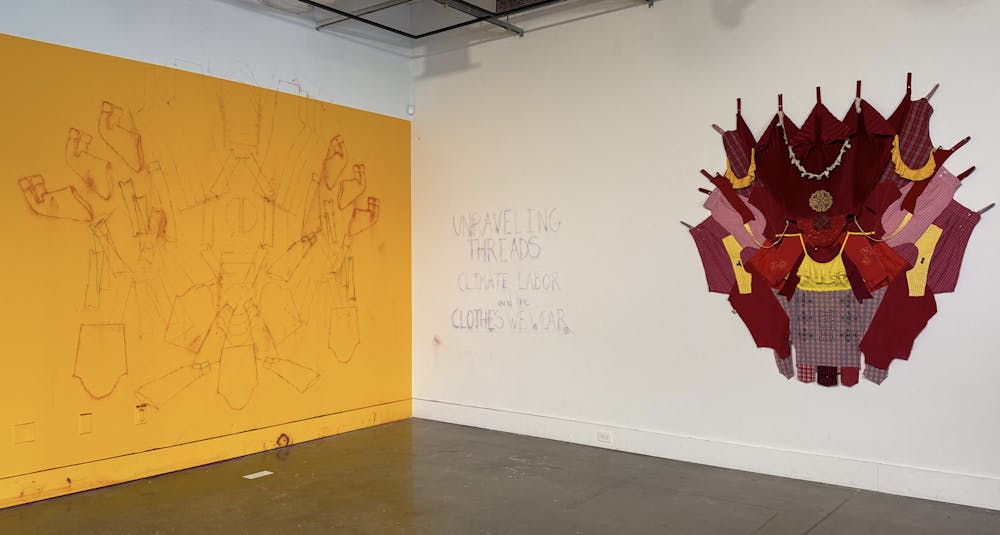
Rachel Breen and her art traveled from Minneapolis to Ewing to showcase her pieces at the College. Breen and Professor Kathleen Webber have been planning this event, “Unraveling Threads: Climate, Labor and the Clothes We Wear,” since last summer.
With only 20% of donations considered useful, Breen’s art repurposes abandoned clothes from Goodwill and other second-hand stores. She flips the garments inside out, takes them apart and transforms them into symmetrical, compelling art pieces. Her work upcycles textile waste that would otherwise go largely unused or end up overseas.
Breen’s journey began with a spontaneous decision to purchase a $3 sewing kit from a garage sale.
After her sewing machine ran out of thread, she discovered a technique in which her stitches resemble those used in pouncing, a Renaissance technique. This sewing pattern is first pricked with tiny holes, then placed onto fabric and dusted with powder, leaving a trail of dots.
Breen uses a similar method in her wall art. From afar, her drawings look like simple lines, but up close, they are revealed to be composed of tiny dots. Soft pastels are turned into powder and “pounced” onto painted walls, creating stencil images derived from pieces of clothing.
Through her wall drawings and unraveled garments, Breen communicates a deeper message about what really happens behind the seams.
“My work is about collective power,” Breen said. “I really want to ground the work within the fact that levels are complex, but also cross borders and past time.”
Incidents such as the Triangle Shirtwaist garment factory fire and the collapse of Rana Plaza in Bangladesh are only just some of the backstories underpinning her pieces. Her work draws attention not only to these tragedies but also to the ongoing struggles of workers in factories with dangerous conditions and unfair wages. Breen has traveled to Bangladesh to conduct research and uncover the realities surrounding garment factories.
Shein, for example, is one of the many companies that mistreat their workers, who earn an average of 6,000 to 10,000 Chinese yuan per month, equivalent to about $831 to $1,385 in U.S. dollars.
When discussing different materials and clothing categories, she said, “that’s a way I remind people about the fact that somebody made these. A human made all of our clothes.
Breen’s pieces highlight colors of red and gold, reflecting her emotions about factory workers, and political turmoil around the world. Red conveys urgency, rage and disappointment, while yellow and gold represent hope and the courage to speak up.
While most clothes contain written texts, Breen’s has symbols. One symbol, in particular, shows two halves of a circle surrounded by the mark of a stitch, representing solidarity and unity.
“The banners themselves contain history and serve as a reminder of the impact of the garment industry,” Breen said.
Editor's note: Professor Kathleen Webber is The Signal’s faculty advisor. She was not involved in the production of this story.