By Jennifer Ampofo
Correspondent
The College’s women’s, gender and sexuality studies department is showcasing the “Amandla is Unity” exhibit from Feb. 6 to March 6. The dates chosen coincide with both Black History Month and Women’s History Month, as a way to spotlight the women and black South Africans who contributed to the end of South African apartheid.
This year also marks 50 years since the 1976 Soweto Uprising, which was a pivotal protest that marked the shift towards South African liberation.
The Soweto Uprising was a series of protests mostly led by middle school students in opposition to the implementation of the language Afrikaans in schools. The language was seen as an attempt to erase South African culture since it was being pushed onto them by their white oppressors.
The choice to display the exhibit during the 50th anniversary of the student-led Soweto Uprising was intentional. “It's important to show how student activism was very prevalent then and now, it shows we still have work to do,” said junior WGSS major Emma Giancristoforo. “I hope it gives people hope and confidence that things will change.”
Marla Jaksch, a WGSS professor at the College, came up with the idea of the exhibit after receiving the artifacts and collection from her late colleague Ángel David Nieves.
“I really wanted to honor him in a meaningful way, and this was the most meaningful thing I could think to do,” said Jaksch.
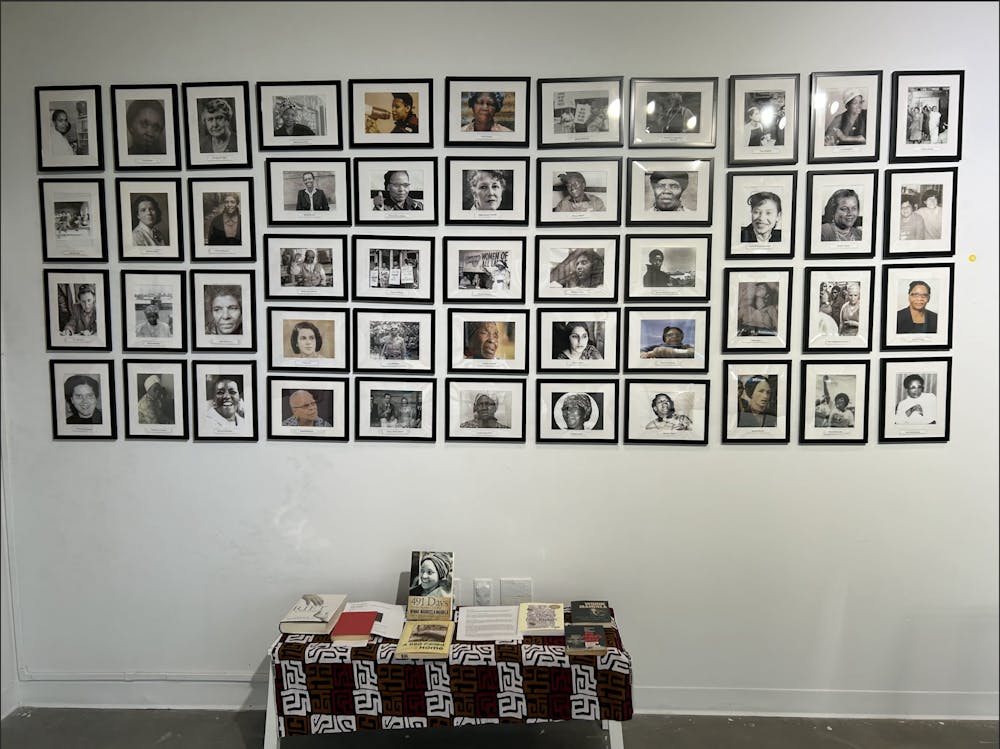
Gallery of women and nonbinary people who helped fight in the movement, accompanied by books made for and about them. (Photo by Jennifer Ampofo)
Roughly two years after the collection was handed over to Jaksch, she asked senior WGSS and English double major Ebony Riley and Nieves’s former graduate student, Cassie Tanks, to help make sense of the collection and find a way to bring Nieves’s vision to life. After planning the exhibit over the entirety of winter break alongside Tanks and Riley, Jaksch invited students from the College to intern in the curation of the exhibit. Giancristoforo was one of these interns.
“I learned that [curating] is very tedious, when you go into a museum or an art show you only see the final product,” said Giancristoforo. “You never really know how fine the details are until you’re actually a part of it.”
It was very important to Jaksch that the display was a collaborative effort and everyone involved had a say in the final product. “I was able to tell the students, ‘Hey I’m not an expert in all this, you have a place and a role in all this,’” she said. “‘Let’s learn this together, we can teach each other new things.’”
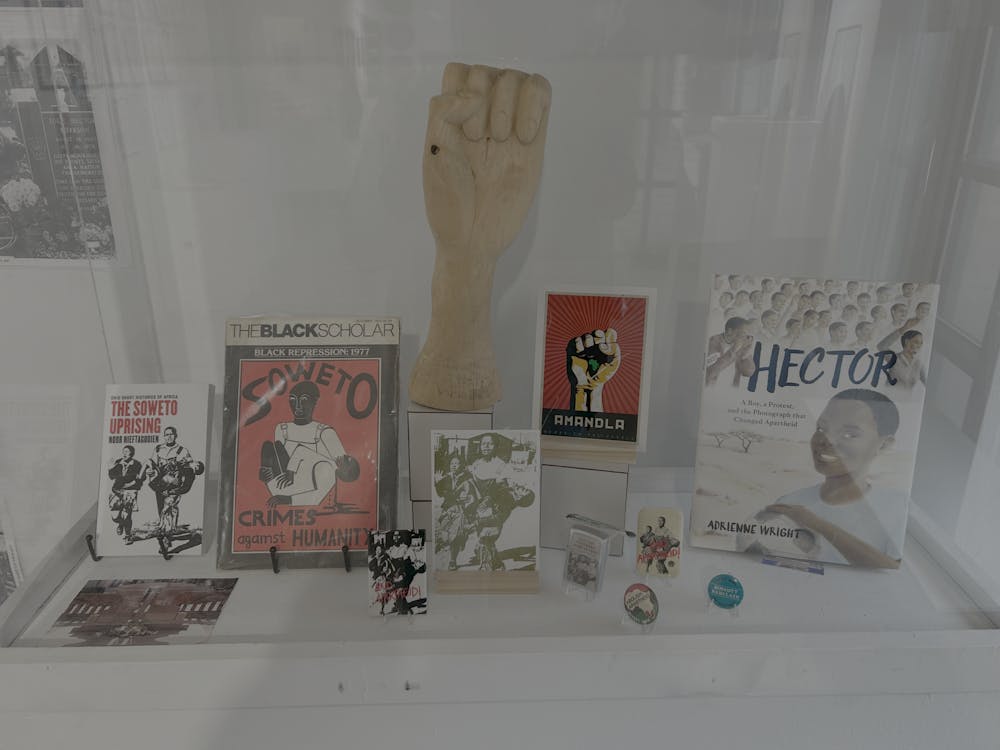
One figure heavily depicted in posters and photographs is Hector Pieterson, a 12-year-old boy who was murdered by police. The photo of his lifeless body taken by Sam Nzima was broadcast all over the country, and eventually the world. This image became the face of the movement and symbolized all the young people who sacrificed their lives.
“It went across South Africa, the continent, and the globe and it sparked outrage because it was really the first time people got to see the reality of the apartheid system,” Jaksch said.
Within a case in the library, there is a newspaper clipping from a 2000 edition of The Signal which recounted Minnie Mandela, Nelson Mandela’s wife, visiting the College. The decision to invite her was very controversial, and the newspaper covered varying opinions on her recounts of South African apartheid and living in a world after it.
Although the library has a smaller and more intimate collection of the exhibit, the Art and Interactive Multimedia Building has two rooms, with one acting as a place for workshops and discussion regarding everything the exhibit encapsulates.
“I have never seen an exhibit split into two rooms before,” said Simmer Jealf, a junior psychology and WGSS double major who viewed the exhibit. “I loved how each room had something new to offer and helped the flow of people viewing the exhibit at their own pace.”
Everything about the display was very intentional, even down to the order of things around the room. Since the display will be up for a month, it’s open to visitors to come during their own time. This led to the prioritization of a friendly, self-paced environment that would allow spectators to have an easier understanding of the flow of events.
The exhibit begins with documents and legislation that initially embedded apartheid within South Africa. A real copy of a passbook is displayed, which was required for Black South Africans to carry when traveling. This was used to police the movement and freedom of Black South Africans within all white neighborhoods.
Although the impacts of the Soweto Uprising weren’t immediate due to police intervention, the widespread audience it reached served as motivation for many people to join the fight.
“We know that apartheid doesn’t end until the early 1900s, but this is really considered the beginning of the end,” Jaksch said.
A section within the exhibit dedicated to Hector Pieterson and the memorialization of his death, including the routes young people took when protesting and the introduction of “Youth Day” in South Africa which honors those who died during the uprising.
“The exhibit reminded me that education is a privilege and a sense of power we might often forget about,” Jealf said.
Further into the exhibit are the names of people who were killed by the military, from the ages of four months to 23 years, juxtaposed by a real military uniform right in the center of the display.
“We added the candles because we really just wanted to honor them, not just commemorate them, but really honor their legacy,” Jaksch said.
The next part of the exhibit shows pictures of Nelson Mandela before and after his presidency and his time in prison, including dozens of photos of women and nonbinary people who helped within the movement.
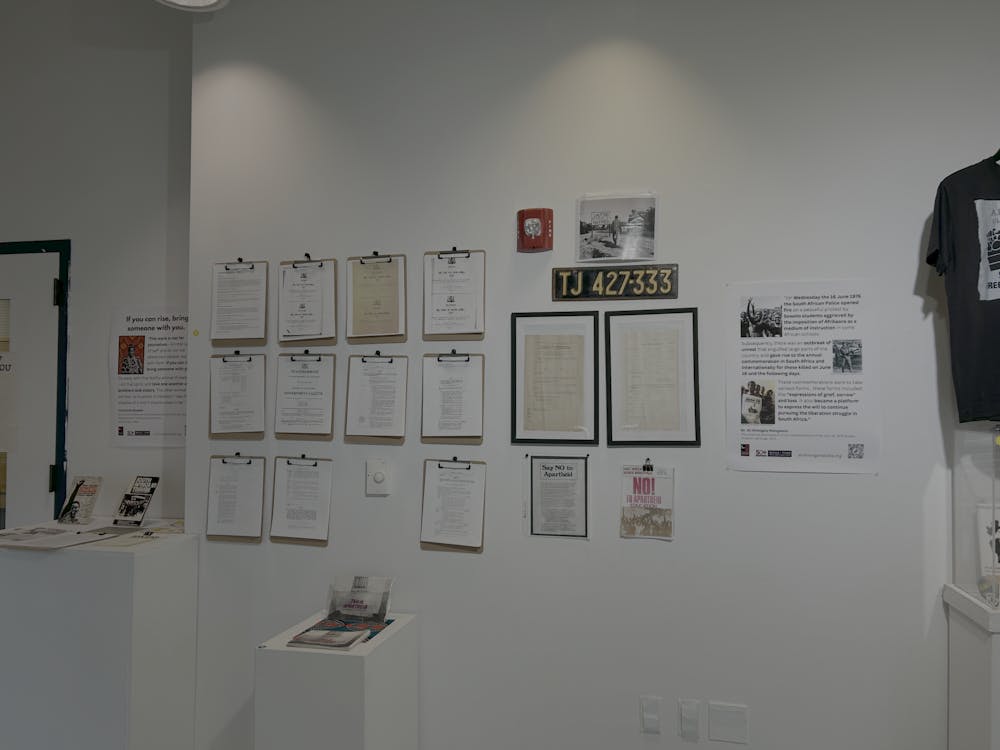
A wall of legislation that restricted Black South Africans's mobility. (Photo by Jennifer Ampofo)
“So many women that gave up everything for the cause weren’t even remembered,” Jaksch said.
The rest of the exhibit displays everyday life and creations by South African people, including traditional clothing, dolls given to girls, a thank you card from a marriage ceremony and photos of traditional South African houses. All of these pieces highlighted that life continued to go on during apartheid, and that Black South Africans did a lot to encapsulate their culture and embody resistance in varying ways.
Room 119 includes a tribute to Nieves to honor his archiving and collection that made the exhibit possible. It also acts as a place to digest all the exhibit includes and take a moment to read more about South African history through a carefully curated book collection.
“It is exhibits such as this one that keep me informed as well as inspire my own personal drive to continue learning about these historical events,” Jealf said. “I hope that TCNJ continues to have these exhibits so everyone can have access and learn from parts of history they may not have known much about before!”
The exhibit is displayed in rooms 111 and 119 in the AIMM building as well as in the lobby of the R. Barbara Gitenstein Library. Since it’s self paced, students are free to visit whenever they want between 9:30a.m.- 7:00p.m. on weekdays.