By Grace Gorsline
Staff Writer
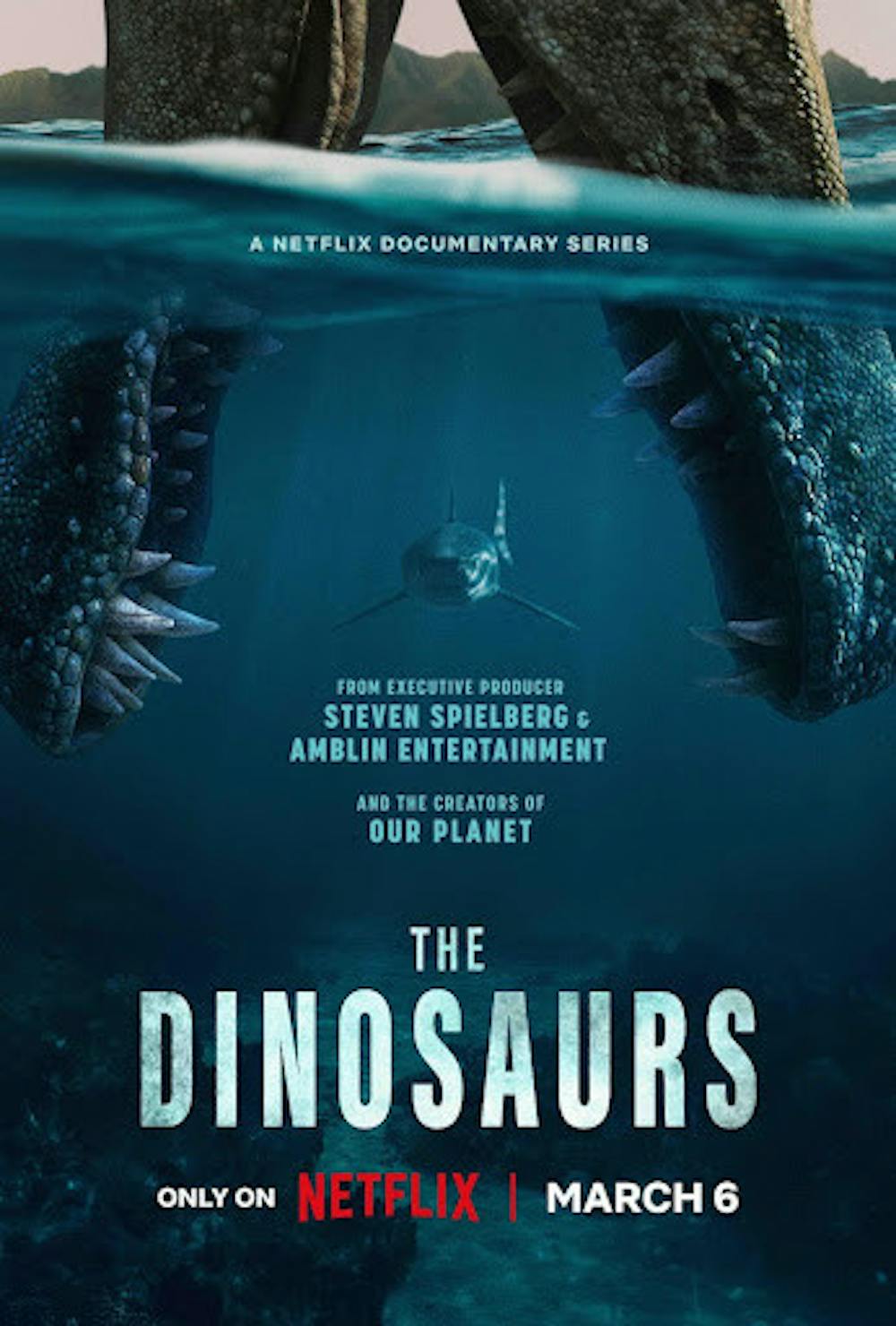
There is so much unknown about the age of the dinosaurs. Their era was filled with unpredictability, competition and was an entirely different world. Netflix’s four episode docuseries, “The Dinosaurs,” explains all that we know about these creatures.
Released on March 6, narrated by legendary actor and producer Morgan Freeman and executive produced by film giant Steven Spielberg, this mini series is absolutely incredible. It stands out from other documentaries as the visuals and graphics are impeccable. There is no real footage of dinosaurs on Earth, but the effects and cinematography of “The Dinosaurs” makes it look like actual clips of dinosaurs on Earth.
Divided into four episodes, “Rise,” “Conquest,” “Empire” and “Fall,” each episode’s title and format is fitting for the dinosaurs’ timeline. Episode 1 discusses ancient reptiles and the species who dominated the planet even before the dinosaurs. Then, it moves on to the birth of the first ever dinosaur, the Marasuchus, and how the survival of that species was the starting point for the evolution of future dinosaurs.
The second episode, “Conquest,” explains the changes Earth went through and the extinction of the ancient reptiles, allowing the dinosaur species to further inherit the world as they evolved not only better survival skills, but also into different species. Through a long series of divergent evolution, spanning millions of years, the dinosaurs grew in numbers, size and adaptations.
Naturally, “Empire” encapsulates the reign of the dinosaurs. The Cretaceous era brings in new creatures with dinosaurs that can swim in the ocean, fly in the sky and flourish in harsh conditions. While there was still a lot of competition and fear over apex predators like the Yutyrannus and the Spinosaurus, dinosaurs ruled the world at this point in time. They created a kingdom unparalleled to any other.
Finally, in the last episode, “Fall,” Freeman narrates the end of the dinosaurs and the massive meteor that ended their dynasty and changed the very foundation of Earth. Moving at a speed 50 times faster than the speed of sound, the meteor landed in the ocean outside of Mexico. It forced the biggest earthquakes the world had ever seen, launched flying debris in all directions and blanketed the world in a shroud of black, blocking the sun’s UV rays.
The meteor was so devastating that if the initial explosion, flying debris, widespread fires or earthquakes didn’t eliminate the dinosaurs, the bitter cold that followed, caused by the blocking of the sun’s rays, would have killed any dinosaurs left standing.
Freeman adds in the conclusion of the series that birds are the distant relatives of dinosaurs. Their survival tactics, physiology and genetic makeup serve as clues to the dinosaurs’ past and should continue to be studied so we can learn even more about the dino dynasty.
Despite the harsh reality of the last episode, the series concluded on a more hopeful note. After discovering the fossils of these animals, we now know more than ever about their world. We have more knowledge about ideas of evolution and made great steps forward in the science of paleontology.