By Franc Romanowski
Staff Writer
A quilt made by the College’s community members could be heading to Washington, D.C. in the near future, following a series of climate quilt workshops throughout February.
The current plan is for the quilt to be part of a larger project, the Climate Quilt Project, which is seeking to display quilts from all 50 states in Washington to highlight the challenges each state is facing due to climate change, according to the project’s website. The project’s goal is to have 1,200 quilts before they plan a national demonstration.
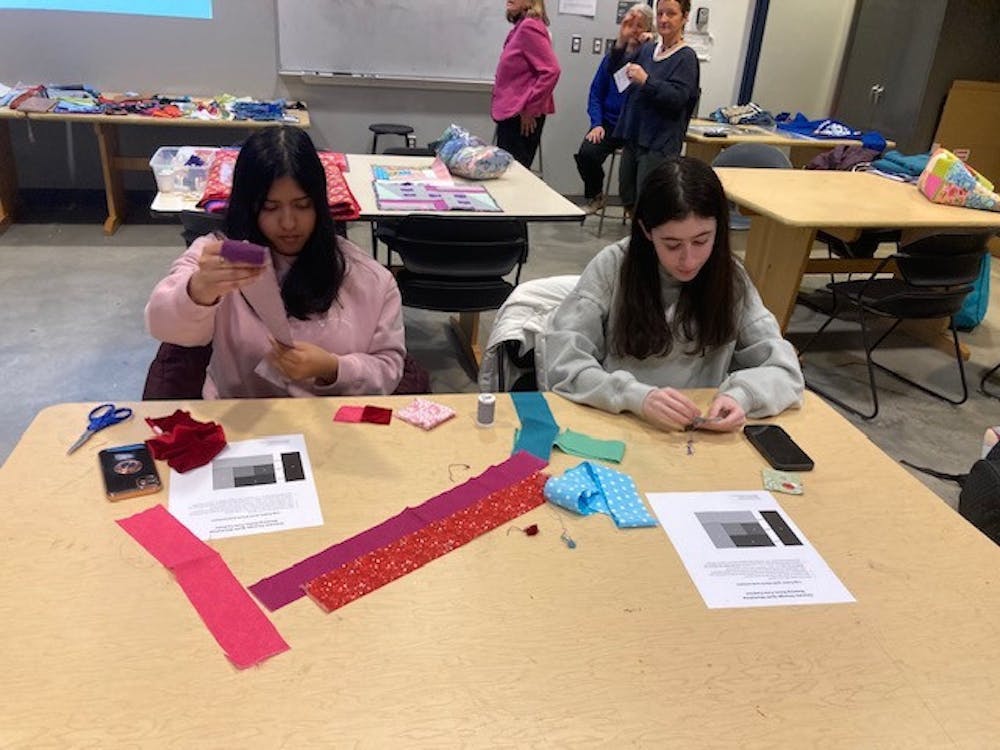
The on-campus workshops were organized by Kathleen Webber, professor and program coordinator of journalism at the College, and run in collaboration with the Environmental Club, Kappa Pi and an arts education class. The workshops began on Feb. 11 and ended Feb. 25.
According to Webber, the planning for the project began in the fall semester, at the same time the planning was going on for Rachel Breen’s exhibit “Unraveling Threads: Climate, Labor, and the Clothes We Wear,” which opened Jan. 28 and is focused on the impacts of the fashion industry. Before the spring semester, Webber met with members of the clubs to work out the design of the College’s quilt.
The decided design includes an image of New Jersey in the center with three different shades of green, from light to dark. The outer perimeter is composed of different images, mainly of plants and animals across the state that are being impacted by the changing climate. It also includes images of how the environment is impacted, such as through forest fires and rising seas, along with an image of wind turbines, to represent a way to improve the climate. Workshop participants individually stitched the fabric together by hand using reused and recycled fabrics.
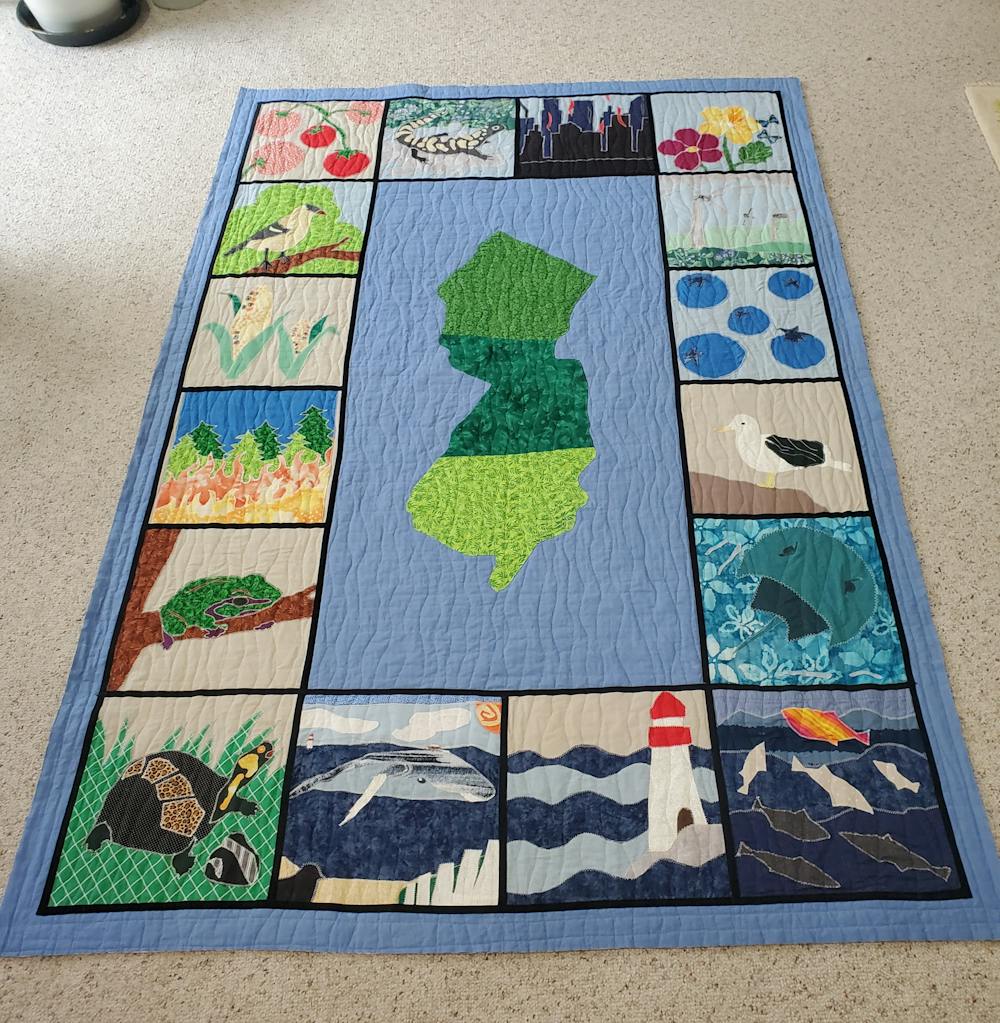
The quilt is called "The Garden State's Changing Tide." (Photo courtesy of Tamar MacLean)
Peggy Cooke, one of the instructors of the workshops and president of the Central Jersey Modern Quilt Guild, sees the project as quilting returning back to its roots. As she explained, quilters used to use worn out clothing and recycled fabrics, like what workshop participants were using, instead of buying new materials. This, she said, is like giving “a middle finger to the fast fashion industry.”
According to the Government Accountability Office, based on 2018 statistics provided by the Environmental Protection Agency, 66% of clothing from the fast fashion industry gets tossed in landfills. This results in the global production of nearly 92 million tonnes of textile waste annually, according to the United Nations Environment Programme.
In the landfills, this waste releases greenhouse gases and has other chemicals that can leech into the soil and drinking water, and can become hazardous to the environment and human health, according to the GAO.
That’s why, for the workshop participants, they’re glad they’re able to have the chance to draw attention to climate change and do something good for the environment in the process.
One of those participants, Stephanie Sookram, a freshman accounting major, said she took an environmental science course and knows about the landfill issue. She also enjoys art projects like this, so “combing them together seems like a good…plan just to spread awareness,” Sookram said.
“We’ve taken these things that have added so much waste to our planet and we’re trying to turn it on its head and…speak that through a quilt,” Cooke said.
“With this climate quilt, it’s been really cool to see students and faculty and professors come from all different backgrounds that you wouldn’t even think they would be interested in doing this,” said Brigette Wixted, president of the Environmental Club.
But for Wixted, the issue is more personal.
“I live on the shore right now,” Wixted said. “I’m seeing how the sea level rises; they’re affecting the shoreline and they’re also affecting the people there.” She added, “[T]his is our only planet, and if we kill it, if we destroy it and if we don’t care about it, then nobody will. And eventually, we’re just not going to be here anymore.”
In addition to the one quilt, a second climate quilt was worked on but for now remains incomplete.
As for the first quilt, the plan is for it to be displayed on-campus by the closing of Breen’s exhibit, according to Wixted and Tamar MacLean, a quilt instructor for the workshops. At the latest, the quilt will be displayed on-campus by Earth Day, MacLean said.
Editor's note: Professor Kathleen Webber is The Signal’s faculty advisor. She was not involved in the editorial production of this story.