By Sky Pinkett
Features Editor
“Like berets hurled into the air / Berets of boys, cocottes and cardinals … / Yet also like a town of umbrellas opened skyward as a shield against rockets / All this is Prague”
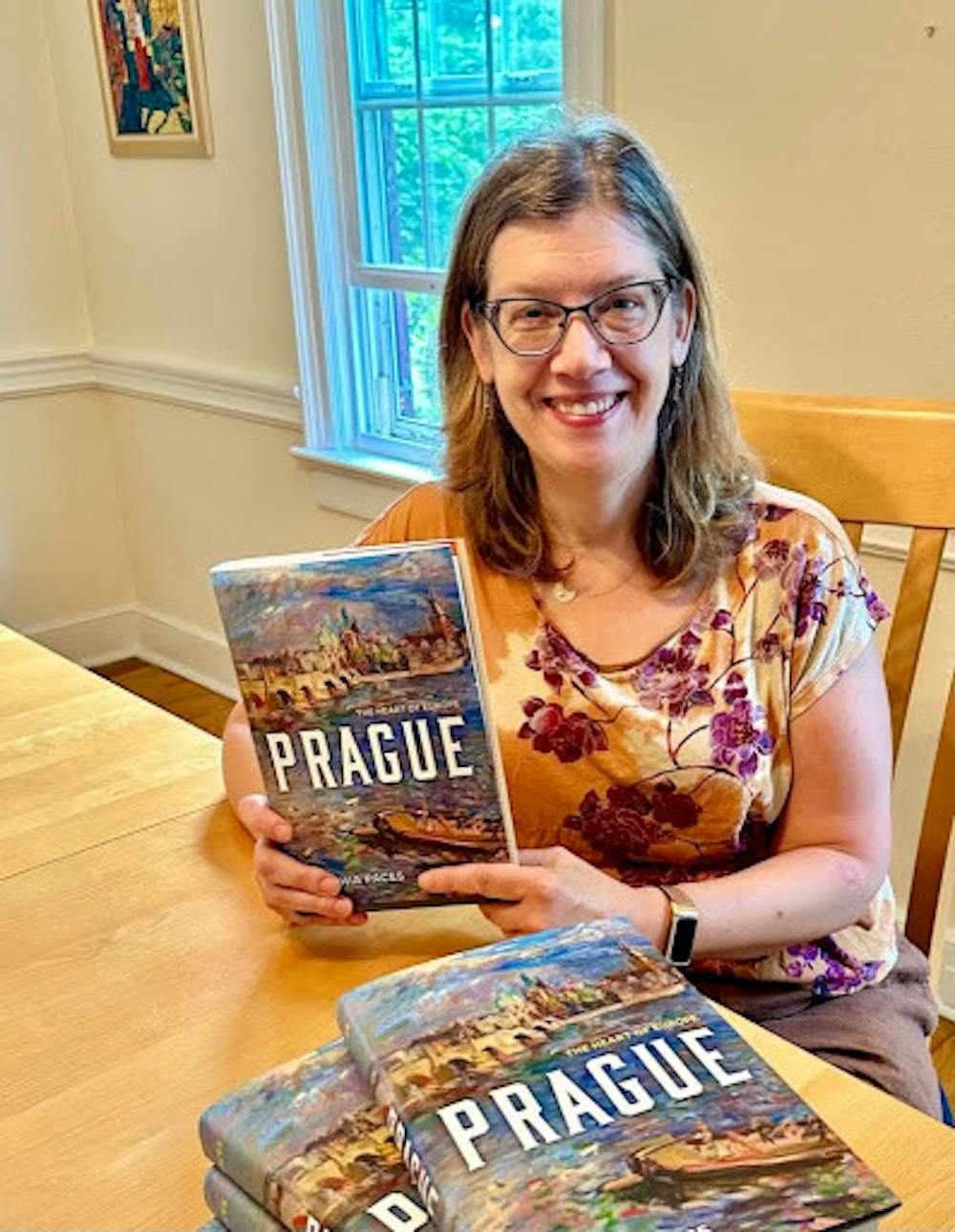
So begins one of the College’s own, history professor Cynthia Paces’s, expansive nonfiction tour de force, “Prague: The Heart of Europe.” These opening lines of the book’s introduction, taken from Vítězslav Nezval’s 1936 poem “Panorama of Prague,” foreshadow all that the reader can expect from the journey through Prague that the book takes us through: times of joy and of pain, of turmoil and of triumph.
“It was one of the largest cities in Europe, and now it's not. Now it's one of those little gems of Europe, I suppose,” Paces said about the city.
Covering a mere 192 square miles as the capital city of the Czech Republic, which shares a border with Germany, Poland, Slovakia and Austria, modern day Prague is best known today as a popular tourist destination with fairytale-like architecture.
With her recently published book, Paces peels back the layers of Prague’s over 1,000 year history, reaching back into the ninth century.
“I was actually approached by Oxford University Press to see if I would be interested because I had written an earlier book that was more specific about Prague in the 20th century,” Paces said. “And they wanted me to do one that was all of Prague's history, which was kind of crazy because it was like over a thousand years.”
The writing, editing and publishing process took about six years in total, starting in 2019. Despite the various challenges that came with the writing process, such as the COVID-19 pandemic and Paces’s teaching obligations, the personal motivation for writing the book kept her inspired.
“My father was actually born in Prague during World War II,” Paces said. “The city was under Nazi occupation when he was born. So then after the war, that's when the communists took over. My grandfather's business was taken over and politically, he was against the communists.”
“My father was about 7-years-old and he had to escape with his brothers and his mother and his father had escaped to Germany earlier. So, I grew up always hearing about these crazy stories of my dad's childhood.”
Once the Berlin Wall fell in 1989 and communism in many Eastern European nations ended, Paces was able to participate in a study abroad program in Prague. That is where she truly fell in love with the city.
“I felt really connected to it. I met some of my father's family there that we had never met before. And so I just started going back and then I went to graduate school to actually study that part of the world,” Paces said. “I went to Columbia University for my doctorate and I focused on Central Europe…here I teach courses all on modern Europe.”
Visiting the physical city of Prague was not only helpful in Paces feeling connected to her heritage, it was also instrumental in her writing.
“When I went to Prague and just could see all the history right in front of me…I mean, you can see like a cathedral from the 14th century and it might be next to a more modern 20th century building, which was really exciting. It kind of got me very interested in that particular place, but definitely my family heritage played a role.”

Paces on a trip to Prague (photo courtesy of Cynthia Paces)
The city of Prague itself has seen much political and social change over the years, from being the capital of the Holy Roman Empire in the 1300s, to the 1419 and 1618 defenestrations (where Prague citizens would literally throw their opponents out of windows) to the WWII event that shook all of Europe: The Holocaust.
“At one point, like in around 1700, there was the highest Jewish population in Europe. There was a lot of culture, a lot of rabbis kind of going to Prague as a center of learning,” Paces said. “Unfortunately, early, early in the war, there were Jewish people, as well as artists from the 1930s, who were being oppressed by the Nazi leadership and came to Prague to escape from being part of the Nazi empire. But it didn't last long.”
The Nazi invasion of Poland escalated matters in Europe. By 1941, the Nazis found their way to the Prague area.
“Unfortunately, the Jewish people there also were deported to concentration camps and most Czech and Prague Jews died,” Paces said.
Even though many Holocaust survivors left Prague and Europe as a whole after WWII, Paces explained how a lot of people visit Prague today to learn about the Jewish heritage in Europe.
“The Jewish quarter in Prague is probably the most intact Jewish quarter in all of Europe,” Paces said. “It has this beautiful old cemetery and several historical synagogues. Because that was not what the Nazis's main objective was there, those buildings just remained and then they were able to sort of be revived more in recent years since the fall of communism.”
All of this engrossing history is part of what makes Prague such a popular place to visit today. Seeing the famous Prague Castle in person, learning about the city’s history and even visiting the many homes of Prague-native Franz Kafka are just some of the activities tourists look forward to. According to Paces, there is still another reason why people should visit Prague and learn more about it through her book.
“I think that as Americans, even though communism ended 35 years ago, there's still a little bit of a mystery about Eastern Europe,” Paces said. “We know obviously about France and Paris and London and Madrid maybe, but the Central European countries are, for a lot of people, kind of undiscovered, which makes it exciting too.”
Paces’s book is helping to break down the mystique of Central and Eastern Europe for those of us living in the West, as it is the first English book that covers the history of Prague in its entirety.
“One of the goals was to kind of write a history that's accessible to anyone,” she said. “It's not very specialized, like only historians will understand this. It's for anyone who wants to travel there or just learn something more about that area. So in a way, I was kind of lucky that it's a little more undiscovered than, you know, some place like London or Paris where there are hundreds and hundreds of books already about it.”
The book’s high ratings on consumer sites like Amazon show that it certainly fits that need. It is currently available to buy online and in physical bookstores.