By Adriana Liberti
Correspondent
Shakespeare 70, a local theatre company with affiliations to the College, was back in the Don Evans Black Box theatre with their third show of the season: Arthur Miller’s “The Crucible.” The production opened on Wednesday, March 25 and closed with a matinee on Sunday, March 29.
“The Crucible,” written in 1953, is set in Salem, Massachusetts in 1692 during the well-known Salem witch trials. It is a story with themes of false accusations, mass hysteria and Christianity. It originally served as symbolism for the “Red Scare,” a time when senator John McCarthy led a paranoid hunt for communists in the United States.
“I thought that was really cool that he connected those two events,” said sophomore English major Kathryn Wyrovsky, an audience member.
Shakespeare 70’s production was directed by Jake Burbage, the Creative Director of the company. In the past, Burbage has directed “Our Town” and “Murder Most Foul,” and has acted in several Shakespeare 70 productions including “The Taming of the Shrew” as Katherin, “Twelfth Night” Orsino and Antonio and “Waiting For Lefty” as Dr. Benjamin.
“It’s difficult to make ‘The Crucible’ tremendously engaging,” said Travis Martin, a sophomore English and secondary education major with a theatre minor, who played Reverend John Hale. “I think that Jake made it feel fresh, and I was so thrilled to work with him!”
The stage was set up as an alley with the audience being on either side of the stage. The floor and walls of the set were painted white to look like floorboards. The play started with Abigail Williams, played by Hayley Jo Pellis, walking out into the woods followed by other young girls trickling in. They talk, laugh and exchange flowers with each other before forming a circle.
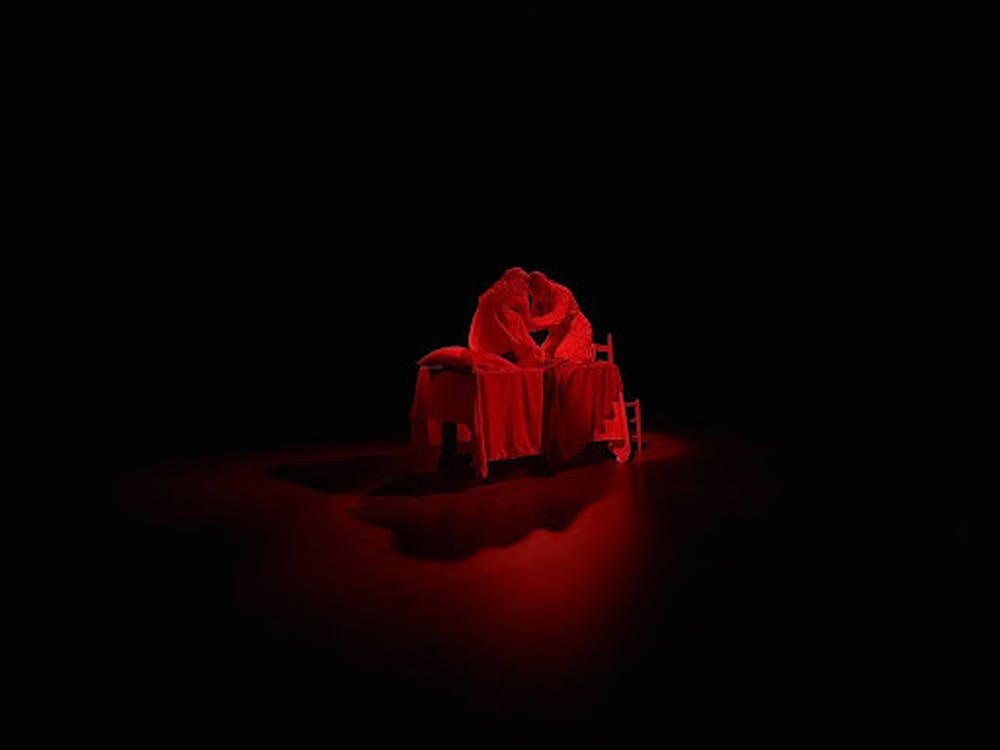
As the lights abruptly change to an alarming shade of red, the girls begin doing choreography to the song “Abbey” by Mitski that is meant to represent performing a ritual led by Tituba, played by Jacqueline Booth.
The girls are caught in the woods by Reverend Samuel Parris, played by Jack Bathke, and his daughter Betty Parris, played by Lydia Hartmann, fakes being in a coma-like state to avoid consequences from her father. Unbeknownst to him, Parris interrogates Abigail about what they were doing in the woods. Abigail claims they were just dancing and denies all accusations of witchcraft.
To avoid punishment, since dancing was considered a sin in their Puritan society, Abigail pretends she and the other girls were bewitched by Tituba into working with the Devil which escalated into mass hysteria when they began shifting blame onto multiple people in the village.
Reverend John Hale is summoned to Salem to help rid the village of all things associated with the Devil. However, his core beliefs are challenged when he realizes how corrupt the court is, making him a more dynamic character in a play full of static morals.
Throughout the play, it is made clear that if someone is accused of witchcraft, they will be punished unless they plead guilty, forcing them to blacken their name.
“The term ‘witch hunt’ is still something that’s very prevalent today,” said freshman English major Andy Cusimano, an audience member. “One person cries wolf, a lot of people tend to cry wolf with it.”
In particular, Abigail accuses Elizabeth Proctor, played by Rachel Lewis, out of jealousy because she had an affair with John Proctor which resulted in deep feelings for him. To save his wife, John Proctor demands Mary Warren, one of the young girls played by Kayla O’Brien, to admit to the court that they have been lying the entire time. While hesitant because she is afraid to go against Abigail, Mary ultimately agrees.
The court room is filled with chaos as accusations are thrown back and forth. The young girls, led by Abigail, pretend that Mary is witching them as the girls are “marvelous pretenders” according to John Proctor.
Amidst the chaos, John Proctor is forced to confess his affair with Abigail as a way to prove the motivation behind her accusations toward Elizabeth. Insisting she will tell the truth, John Proctor begs the judge to bring Elizabeth in so she can second John’s confession. However, this backfired when she lied about the affair with the intention of protecting her husband.
With one final performance from the young girls, Mary turned against John Proctor and called him “the Devil’s man.” Abigail pretended Mary was sending out her soul in the form of a yellow bird that was making her and the other girls repeat everything Mary was saying. As a light in the shape of a bird swept across the stage floor, the court room went from neat to messy. With flashing lights, the girls took their chairs and spread them across the stage.
John Proctor, now accused of witchcraft, was coerced into giving a testimony stating he has been in contact with the Devil. Even though he was able to confess, he refused to hand over the signed testimony and tore it up instead. “I’ve given you my soul; leave me my name!” he cried.
The play wrapped up with John Proctor being hung, portrayed by him standing on a table with a noose around his neck, and Elizabeth hugging Abigail while sobbing into each other’s arms.
“I didn’t really care for it when I read it,” said audience member Katie Gallagher, a junior Art Education major. “I think it makes a big difference actually seeing it and performed live.”
With the pressure of doing a play that is highly well-known, Shakespeare 70 put on a very emotional and well-done production of “The Crucible.”