By Sky Pinkett
Features Editor
Two thousand kilometers long, temperatures that can reach over 100 degrees and not a single body of water or place of shelter in sight. Sounds like a fun vacation spot, right?
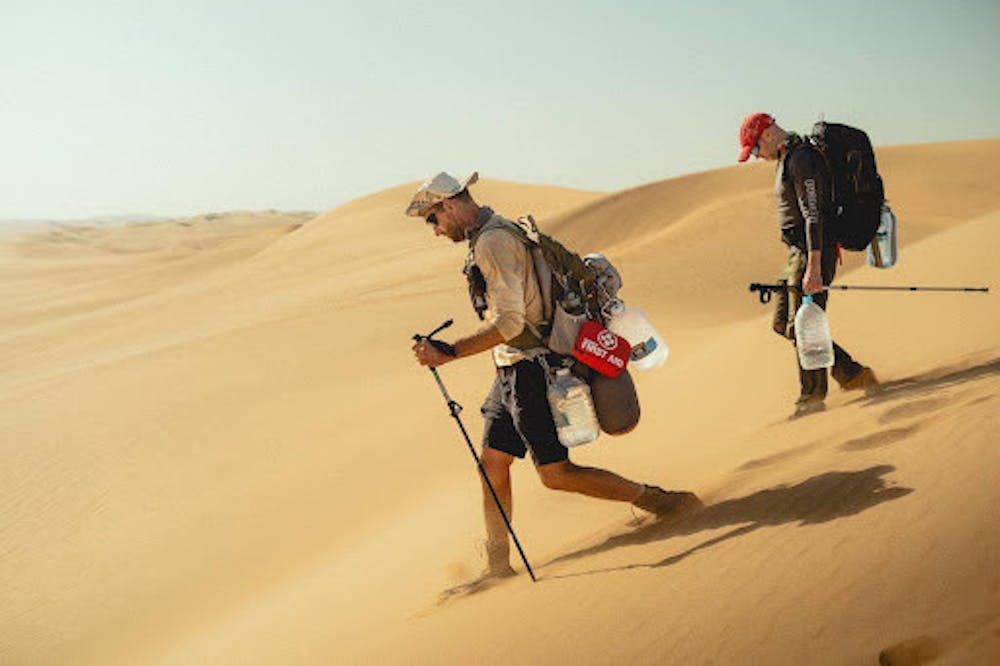
This difficult terrain is the Namib Desert. And in 2024, archaeologists George Leader and Dominic Stratford spent 12 days braving this harsh terrain in the name of research.
“I work in Africa, southern Africa,” Leader said. “I study human evolution archaeology, so human beings' ancestors. I study deep time human evolutionary archaeology.”
Leader spends many summers in South Africa and Namibia collaborating with an international research team that engages in field work. For him personally, he has a very specific aspect of human archaeology that he’s passionate about exploring.
“What I'm really interested in are the stone tools that our ancestors made about a million and a half years ago,” Leader said. “So that's sort of my area of expertise. And in the Namib Desert of Namibia, it's the oldest and one of the driest deserts on the planet where there's evidence that our ancestors like Homo erectus were occupying that space.”
With this being the case, Leader and his best friend and colleague, Stratford, set out to explore the Namib Desert with a series of questions they were seeking to have answered about our human ancestors.
“What we're interested in looking at is when could these hominids live in this desert? It's very dry now, but at certain times it was wet when rivers broke through. And so which kind of environment was it?” Leader said as he went through their list of questions. “Was it sort of this when a river broke through, was it a tiny little stream? How much vegetation did it support? And thus, did it support enough that we find fossils of… all these animals? So we're basically trying to reconstruct the environment as it was 500,000 years ago when Homo erectus was still moving through there, or 100,000 years ago when modern humans were actually out there. That's our goal research-wise.”
To describe their work more clearly to those unfamiliar with the archaeology field, Leader gave a relatable example.
“So if a developer said that they were going to take a big, empty piece of land where you're from… and they're going to build 100 new houses in a development there, you would want to send archaeologists first to see if there's any old Native American sites or old historical sites that were important that need to be saved and studied. And so you would have archaeologists walking back and forth and maybe digging some test pits to look for the kind of artifacts that were there.”
“The same is really true for what we're doing here in the desert,” Leader continued. “But we just did it over 160 kilometers over an entire desert.”
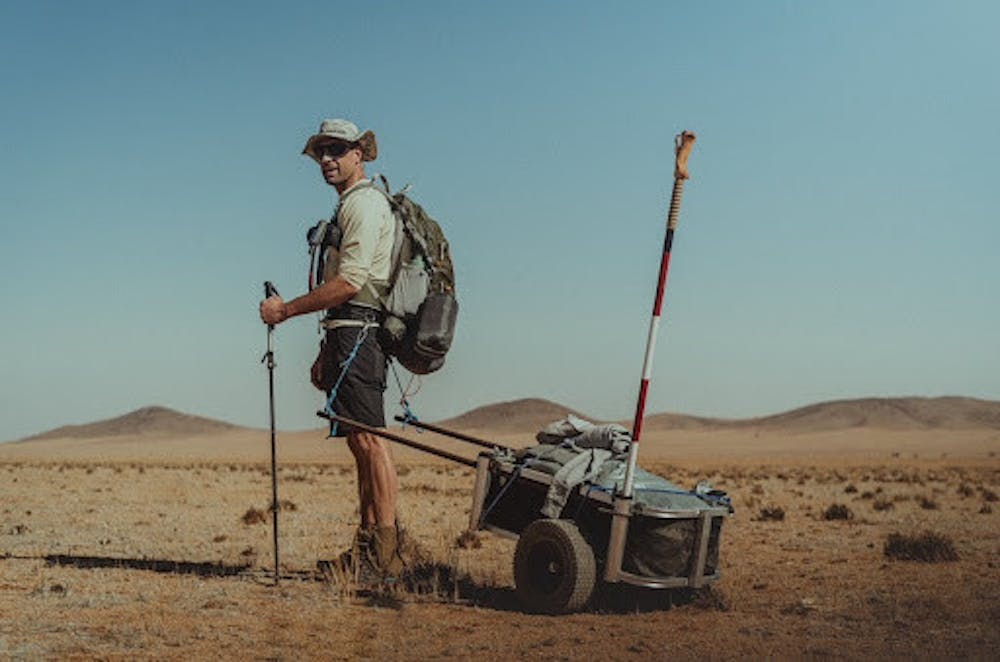
George Leader walking in the Namib Desert. (Photo courtesy of George Leader)
George Leader walking in the Namib Desert. (Photo courtesy of George Leader)
Because of the extreme environment of the Namib Desert, Leader and Stratford originally decided to reduce their exploration team to just the two of them. However, as the remarkable prospects of their trip settled in, they decided that this incredible experience was something worthy to be shared with the world.
“We were like, man, this is actually going to be really cool and totally different than the normal archaeology we do. It's kind of adventure-y… I get filmmakers that reach out to me regularly because everybody's looking for cool archaeology in Africa and exciting, really neat things to film, and we never do it. And we're just like, well, let's just reach out to them.”
This trek would be no walk in the park. Leader and Stratford, along with their filmmaking crew, had to prepare meticulously for the journey and plan every aspect.
“The research station is just outside of the desert. We were dropped off…and we walked all the way across this.” Leader said as he pulled up a map of the Namib Desert, drawing a line right through the middle of it. “We walked across this over 12 days. And then we were picked up on the coast here by professional drivers who drove us all the way up the coast back to Walvis Bay where we got a nice big cheeseburger and milkshake and enjoyed that very much. Then about an hour-and-a-half on dirt roads back to the research station where is our point for research.”
Even with all their planning, the team still faced some close calls. As the trailer for the documentary hints at, the Namib Desert challenged the crew with tall sand dunes, supply transportation issues and a lack of water, electricity and shelter.
Nevertheless, the team pressed on and found some pretty interesting findings as a result, as well as many new unanswered questions. But as Leader told The Signal, that’s a big part of science itself.
“The best part about research is that you always get some answers, but you sometimes end up with more questions than answers,” Leader said.
The unanswered questions Leader and Stratford left with have motivated them to seek further answers on future trips to the Namib Desert. But for the present moment, Leader’s biggest takeaway from the trip was how he could use the experience to broaden student minds on what science can be.
“I am excited that I get to communicate my science with the world a little bit,” Leader said. “That's the important thing. Science doesn't have to be dressed up to be fun and exciting for everybody. I want to get my students excited about fieldwork, research and science. I hope that it brings something special and unique to my TCNJ students.”
The goal for Leader in his archaeology practice, and one of the non-research related objectives of the Namib Desert trip, wasn’t necessarily to entice other students to make groundbreaking trips to remote locations in the world. Rather, he hopes to use this trip to foster a passionate love of learning in his students that will transcend college.
“How many of my students would have ever cared about little broken rocks in Africa?” Leader chuckled. “Maybe not. But the next time they see an article on CNN or BBC or a website about that, they'll say, ‘hey, I know about that; That's interesting.’ It will continue to foster lifelong learning.”
The trip’s documentary, Across the Namib, is gearing up to be widely released to audiences in the future. In the meantime, viewers can check out the trailer on YouTube.