By Molly Tursi
Staff Writer
Writing far from his home in Salinas, California, author John Steinbeck had grown apprehensive of what would become his seminal novel, “East of Eden.” Literary acclaim for earlier works such as “The Grapes of Wrath” and “Of Mice and Men” had established Steinbeck as a pillar of American fiction, yet he knew his best work was yet to come.
“This book will be the most difficult of all I have ever attempted. Whether I am good enough or gifted enough remains to be seen,” the author wrote in his dedicated journal.
After 11 years of conceptual development, “East of Eden” was published by Viking Press in September 1952. The novel overcame initial criticism and won over readers, who raised it to No. 1 on the fiction best-seller list.
Writing the novel so that his sons could understand their lineage, Steinbeck sought to preserve the essence of Salinas through the sweeping 600-page long generational saga of the Trask and semi-autobiographical Hamilton family.
“East of Eden” takes its name and thematic form from the biblical story of Cain and Abel, as depicted in Genesis 4:16. The story of brotherly rivalry is alluded to twice over, starting with Adam and Charles Trask, and repeating with Adam's sons, Aron and Caleb Trask.
“East of Eden” was adapted for film in 1955 by renowned director Elia Kazan. The film debuted James Dean in the leading role and was the only film to be released before his untimely death the same year.
While Elia Kazan’s adaptation remained the only high-budget production of the novel for over seven decades, the film only covers the final third of the novel. Consequently, Steinbeck’s full epic had been pushed to the wayside, beckoning for another visionary to pick up the pieces.
Fortunately, Elia Kazan’s favor for “East of Eden” is hereditary. In 2022, Netflix announced that his granddaughter, American actress and writer Zoe Kazan, was attached as writer for a limited series adaptation of Steinbeck’s full novel.
“East of Eden” wrapped production in March 2025, a year after beginning principal photography in New Zealand.
Despite the distinct American setting of “East of Eden,” the series was filmed predominantly in New Zealand locations, including Auckland, Dunedin and Oamaru. Cinematographers Stuart Dryburgh and Sam Chiplin imagine a stunning imitation of Salinas through picturesque vistas and bucolic landscapes, which is complemented by nature’s ambience and a painstakingly beautiful score composed by Laura Karpman.
“East of Eden” premiered on Netflix on Oct. 1, 2026. Zoe Kazan served as creator, executive producer and screenwriter, working alongside co-showrunner Jeb Stewart and the production companies Anonymous Content and Fifth Season.
Zoe Kazan distributes Steinbeck’s sprawling American saga across seven moderately paced episodes. The series is divided between directors Garth Davis and Laure de Clermont-Tonnerre, with Davis directing episodes one through four and Tonnerre directing five through seven.
Davis and Clermont-Tonnerre’s directorial techniques mesh seamlessly, leaving behind no tonal shift at their passing point. Each stylistic choice is vivid and intentional, without diverting attention from the plot-driven narrative.
“East of Eden” opens with the jarring introduction of Cathy Ames, who drags herself onto the porch of Adam and Charles. Mangled and blood-stained, Cathy’s appearance foretells the magnitude of carnage her presence will wreak on the Trask family, who mire her into their own tortuous lives.
In Netflix’s rendition of “East of Eden,” Cathy is the catalyst of the story. Regarded as baseless in Steinbeck’s novel, Zoe Kazan gives Cathy’s malice a causal reason to be. Burdened by sexual trauma and the gender limitations of the 19th century, Cathy makes ruthless choices to regain her agency. As she becomes hemmed in by the men in her life, she thrashes against a lack of control and free will.
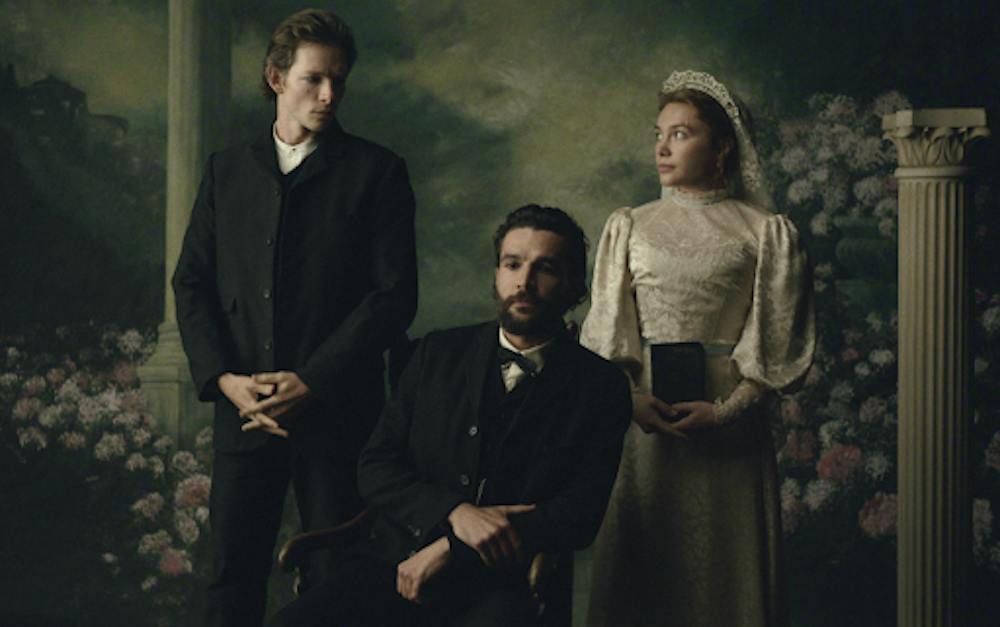
Delivering the performance of her career, English actress Florence Pugh upstages herself as the hard-bitten Cathy. Known for films such as “Little Women,” “Black Widow,” “Don’t Worry Darling” and “We Live in Time,” the actress tends to take on resilient, though morally complex female characters. In “East of Eden,” Pugh humanizes Cathy’s serpentine temperament so that viewers may understand the human nature of villainy.
Actors Christopher Abbott and Mike Faist play the Trask brothers, who reconcile as adults following a resentful adolescence. Faist, whose performance moved Netflix to add an extra episode for him to feature in, is exceptional as Charles. As the rejected son, Charles is made brusque by years of isolation, yet his fondness for Adam prevails through his indignation. Faist is raw and reactive in his portrayal of Charles, representing the anguish of snarled family ties.
Abbott’s depiction of Adam is striking yet rightly subtle. Although innately kind, Adam’s goodwill is degraded by Cathy’s wiles, leaving him vulnerable to the abandonment and manipulation that engenders the tragedy of the story. Facing lone fatherhood, Adam becomes stolid and unaffecting, which Abbott expresses through guarded facial expressions and laconic line delivery.
Hoon Lee is the heart of “East of Eden,” playing the Trask family’s brilliant Chinese American servant and caregiver, Lee. Lee embodies the humility, compassion and intelligence of his character with naturalistic ease, while subverting the historical Chinese American stereotype. Graciously becoming the father figure that grief-stricken Adam is incapable of, Lee signifies that family is a choice, not a given.
“East of Eden” revolves around the thematic motif of “timshel,” a Hebrew word translating to “thou mayest.” The word hearkens back to the Book of Genesis, in which God tells Cain, “Thou mayest triumph over sin.” Severing the residual binds of Cathy’s evil, the Trask family finds absolution in free will over fate.
As Zoe Kazan told Netflix, “‘Those terrible things, whatever they may be, those shameful things, don’t overshadow our ability to choose now and to learn and change.”
“East of Eden” justly stakes its presence in each generation, standing strong as a monument of American storytelling. Zoe Kazan’s adaptation transcends Steinbeck’s original text, serving as a moral cautionary tale and contemplative study of the cruelty of humankind.