

By Aidan Krause
Staff Writer
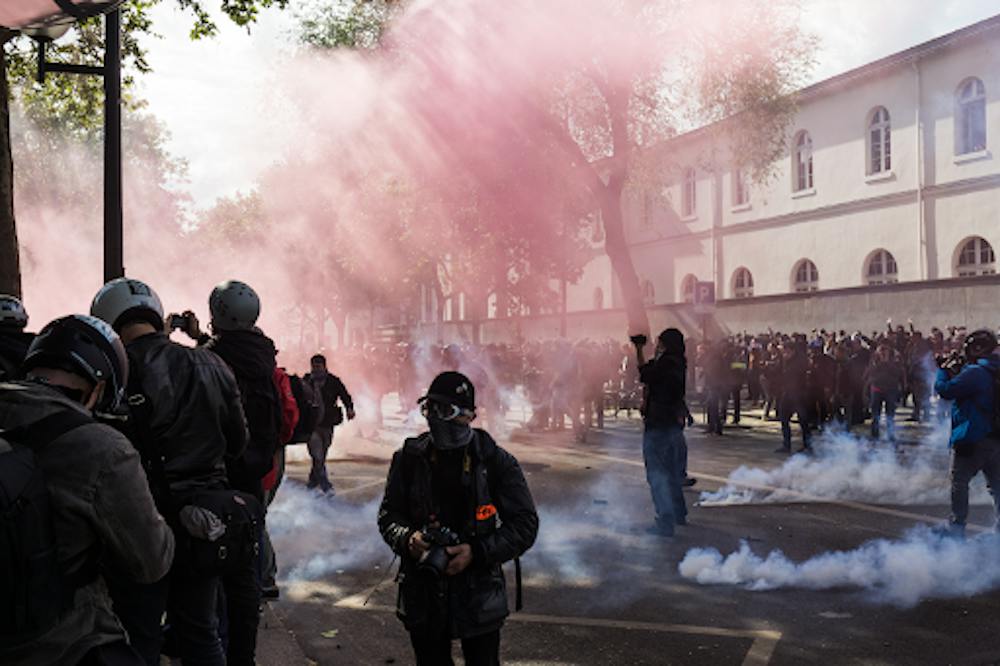
The largest French student protests in decades erupted at the end of September, including marches held in 40 French cities as far-reaching as Caen to Marseille, The New York Times reported.
One protest drew a crowd of 256,000 people on Oct. 6, while roughly 6,000 people have been arrested since the unrest began.
One of the first protests was at Saint-Exupéry High School in a Paris suburb, where students joined teachers in protesting against a lack of staff and school resources. While students' and teachers' demands were eventually met, other protests quickly started at separate schools in Paris and the surrounding region, according to CNN.
The initial issues arose from a high birth rate in 2010, as well as the number of teachers in secondary schools now being lower than in 2008, even though there are 250,000 more students enrolled. This means that in public schools, 70% of classrooms have more than 30 students.
The student union leaders, who represent a portion of the students protesting, have drawn up a 10-point list of proposals including reworking student workloads, the university admissions system and ending police violence against students, CNN reported.
The student unions have also called for a 11.2 billion USD investment in high school and university education. The spokesperson for the Student Union federation of unionized students, Sabrine Kharbach, stated that “blockades would continue until their demands were met.”
The largest of the protests occurred on Oct. 6, during which a 14-year-old's jaw was shattered by a police tear gas grenade; the officer who fired it was later arrested. In the town of Lens, a 15-year-old lost a hand in an incident with a police stun grenade and a 16-year-old was supposedly partially blinded by a police riot control round, according to The Associated Press.
Following the incident of the 15-year-old losing a hand, Interior Minister Laurent Nunez announced on Oct. 7 that the model of stun grenade used will no longer be utilized against high school students.
Alongside the students in Paris protesting with a white armband on Oct. 6, was Jean-Luc Mélenchon, a leader of France's far-left party, France Unbowed. He called on students to take to the streets in protest but added that “You must use nothing but nonviolent methods of struggle.”
Interior Minister Nunez, responding to Jean-Luc Mélenchon calling on students to join the protest, said to the party leader while in the National Assembly, “Why wear a white armband to better give a leg up to those wearing black balaclavas?” And that “violence is part of your political plan to throw the country into chaos between now and the presidential election,” The New York Times reported.
The Interior Minister still stands by police action, defending it by stating that, “police have been obliged to intervene when protests led to rioting, vandalism and other violence, and have done so mindful that they’re largely dealing with children.”
Also among those who joined the protests was a rising star within the France Unbowed party, and the mayor of Saint-Denis, Bally Bagayoko, who listened to students, assisted in putting out small fires set by disruptors, and fielded questions with journalists.
Critics of Mr. Bagayoko highlighted an interview he gave outside an early blockade of a school in which he stated that, “Violence, at a certain point, can be legitimate.” However, Bagayoko was quick to add that his message to students was that it's always better to avoid violence.
After the massive demonstrations on Oct. 6, in which labor union members, parents and teachers joined the students in protest, Prime Minister Sébastien Lecornu announced that the government had heard protesters' demands and that regular classes would be suspended on Oct. 8 and 9 in order to come up with a solution, according to The New York Times.
The demonstrations come at a pivotal time for France, in which presidential elections are scheduled for April. Polls show the far-right candidate, Marine Le Pen, has a chance to succeed current President Emmanuel Macron, The New York Times reported.
As far as action to solve the students' stated problems, Prime Minister Lecornu said that parliament would debate a budget that includes 71.6 billion USD, slightly more than last year. Lecornu also said that the government has launched five initiatives, including school renovations and improvements to student schedules.
However, the situation did not improve as of Oct. 8, as a reported 224 high schools were closed, leaving 94% of high schools closed or partially open, and demonstrations roared on.
Overall, 700 police officers and 300 students and school staff members have been injured, some seriously. Some high schools were ransacked, set on fire and heavily damaged as of Oct. 8.
Some have compared the mood of the protests to May of 1968 when mass protests, nationwide strikes and street battles affected France. Julian Bourg, a professor at Boston College, however, said that the recent protests differ by remaining more tightly focused on education conditions, according to The New York Times.
Bourg continued by saying, “That said, each major French protest movement does raise the possibility that the demands of a specific cohort may lead to more generalized protest and a broader political crisis,” he said. “That is the echo of 1968.”
In a speech to the nation on Oct. 7, Prime Minister Lecornu pledged to address student grievances and also said that “young people’s anger doesn’t come out of nowhere,” and he urged students to “choose their path and look to the future with confidence.”
One response to Lecornu came from one 17-year-old, Augustin Lassaab, who said, “His speech motivated us to keep blocking our school until the government stops refusing to listen to us and responds to our demands,” adding, “we will not stop.”


.jpg)