By Molly Tursi
Staff Writer
In the changing months between October and June during the Victorian period of literature, English author Emily Brontë dedicated herself to writing her first and only novel, “Wuthering Heights.” Published under the anonym “Ellis Bell,” the novel was released in December 1847 to a critically engaged readership.
Classically steeped in the damning qualities of strata, patriarchy and the ruins of infatuation, Brontë’s “Wuthering Heights” has become a literary benchmark since its publication. For over a century, the novel has concentrated its presence within classroom curricula, cinematic adaptations and the enduring topic of literary criticism and theory.
Following the fate of literary prominence, adaptations are an inevitable outgrowth of a novel’s influence. “Wuthering Heights” has spurred a plethora of adaptations, crossing through dramatic formats such as film, television, theater, music and even more literature.
In 1939, “Wuthering Heights” was brought to visual fruition by filmmaker William Wyler. Until this point, Wyler’s adaptation has largely been considered the best adaptation of Brontë’s classic. Despite inaccuracies and the complete elimination of the novel’s second half, the film was nominated for Best Picture at the 1939 Academy Awards.
Almost a century after Wyler’s picture, the English filmmaker Emerald Fennell took to the moors to develop her own rephrase of “Wuthering Heights.”
Proceeding months of commotion and scattered scrutiny, “Wuthering Heights” was released to a wide audience on Feb. 13. During its opening weekend, the film generated $82 million at the global box office, which exceeds its budget of $80 million according to Newsweek.
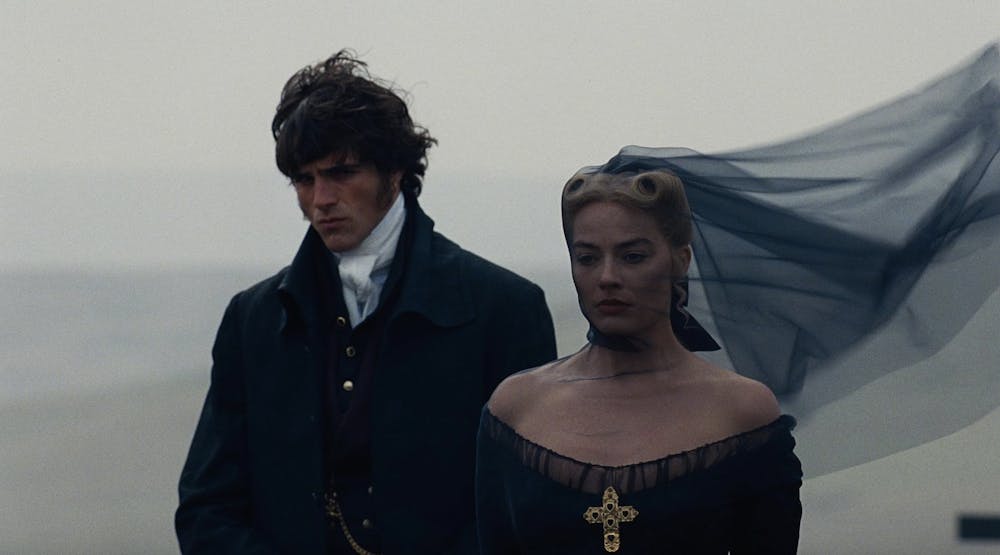
Fennell’s stylistic adaptation of “Wuthering Heights” centers around characters Catherine and Heathcliff, whose clandestine love spans across years of resentment and turmoil. Starring Margot Robbie and Jacob Elordi, Fennell embellishes the story with familiar talent.
“Wuthering Heights” soundtrack is masterfully fit to size by musician Charli XCX which was released as a full album with the same title. The most notable song, “Chains of Love,” encapsulates the haunting ambience of the film and has since amassed over 30 million streams on Spotify.
Although the film is wrought with talent and ambitious craftsmanship from Fennell, its admirable qualities fail to save “Wuthering Heights” from becoming a travesty of its original source.
Denuded of complexity and character, Fennell’s “Wuthering Heights” expropriates Brontë's tale of tormented love and whittles it down to a vapid mass of Gothic erotica. There is hardly room for depth beneath the stance Fennell took on the story, which is dominated by lust in place of Brontë’s intellectual themes.
Pointing back to her previous films, “Promising Young Woman” and “Saltburn,” Fennell’s work specializes in stories of vengeance and depravity. While “Wuthering Heights” is attuned to the director’s affinity for staggering themes and character driven storylines, her creative liberty evades the ruthlessness of Catherine and Heathcliff's relationship and weakens the durability of her interpretation.
“It's where I filled in the gaps aged 14,” Fennell told BBC, furthering that the film allowed her to “see what it would feel like to fulfil my 14-year-old wish, which is both good and bad.”
Embodying exactly what a 14-year-old would want to watch on a Friday night, Fennell’s “Wuthering Heights” excels at playing a mawkish interpretation of the story. By eliminating the guarded nature of Catherine and Healthcliff’s sensuality, there is a yawning gap in the story’s structure.
While the film’s boldness and experimentation of style is at the root of its detriment, Fennell’s “Wuthering Heights” is undeniably the most daring imagining of the classic yet.