By Natalia Tomczak
Opinions Editor
Period poverty, the lack of or uncertain access to menstrual products due to financial restraints, is on the rise in the United States and globally. In the U.S., One in four teens struggle to afford period products. This is a human rights concern, public health crisis and a reflection of gender inequality.
Women are most susceptible to period poverty between the ages of 18 and 25, a time when many people leave their family home to pursue an education or career. This has a greater impact on mental health, creating a feeling of disempowerment as basic needs are not met. Period stigma can also make it harder to ask for help.
When women experiencing period poverty were asked how their lives would be different with unlimited access to period products, 37% said they would worry less about finances, 24% said they would explore different profession opportunities, and 17% said they would explore different educational opportunities. For women in school who are currently experiencing period poverty, school attendance, grades and class participation are affected.
At the College, health concerns are assessed through the ACHA-National College Health Assessment (NCHA). This is a nationally recognized research survey that the College emails to students for them to complete every other year in the spring semester. It asks questions about physical, mental and sexual health, but there was only one question regarding periods, which asked about the degree to which Premenstrual Syndrome, painful periods or menstrual cramping have affected academic performance.
The College has a few different locations for providing products for free. The Title IX office on the second floor of Brower Student Center distributes products while the student center is open, which is from 7 a.m. to midnight Monday through Friday, and from 9 a.m. to midnight on Saturday and Sunday. Products are distributed from The Shop in Campus Town, the Dean of Students office in the Student Center and through Student Health Services in Eickhoff Hall as well.
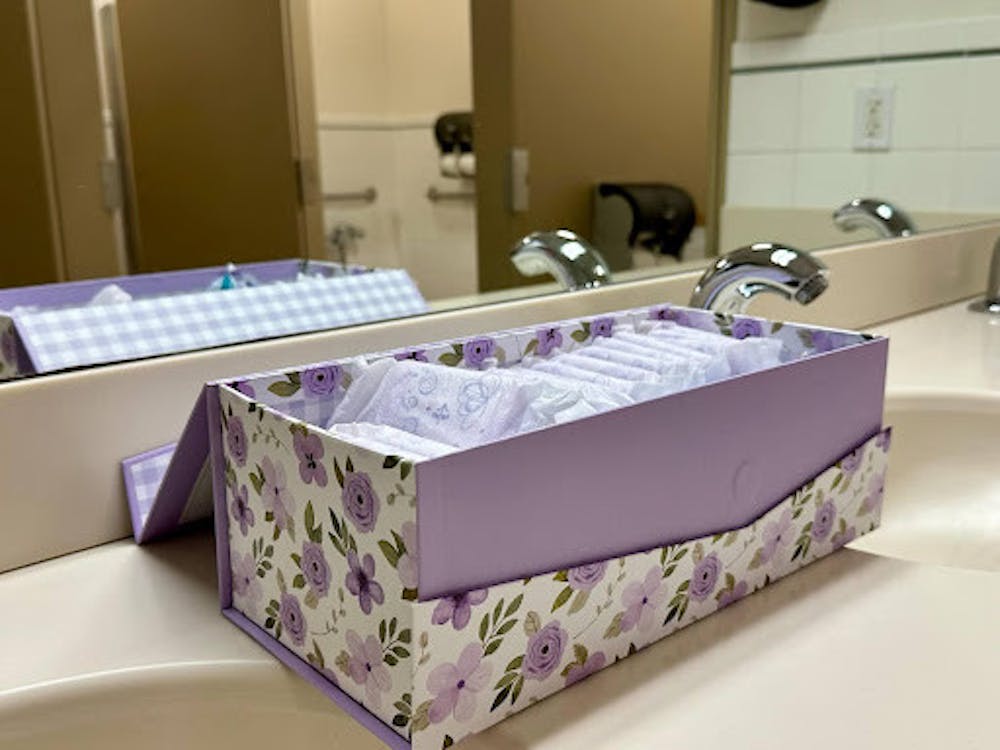
Period products can be found in the bathrooms of various buildings as well, but that process is not centralized through the College’s facilities for them to distribute throughout campus.
Beth Gallus, associate dean of students at the College, said that in regards to funding, “We’ve gotten grants every year for The Shop, and so The Shop will make purchases from the grant. Sometimes we might make larger purchases, and so we’ve had a lot of big quantities.” The Shop also accepts donations, and through its Amazon Wishlist, needs can be met.
Jordan Draper, associate vice president for student affairs and dean of students, said, “I think we had a period of time, three or four years ago, where there were requests, and then when we started giving them out for free, the requests stopped coming in. So I think anecdotally, we felt like we were meeting a need. But certainly there’s always ways to improve it. We’re always happy to address that if students are needing that.”
Sophomore Sophia Kim, an early childhood education and women’s gender and sexuality studies major, when asked about access to period products at the College, said that it could be better. She says, “I am aware that the campus claims they provide free menstrual products, however I’ve only seen them in two buildings. All of the bathrooms I’ve noticed had ‘free period products’ were empty and not restocked. I’ve only ever seen consistency in the second floor of Roscoe West and in the Student Center in front of the Title IX Office.”
Kim adds, “Something I have seen in some bathrooms is a QR code to fill out when the menstrual products are out of stock, however I’ve only ever noticed it in the education building, and I'm not sure of the accuracy and urgency provided.”
Sophomore Isabella Dani, a fine art major, said that a variety of period products are lacking.
“The College, in my opinion, does not provide adequate access to menstrual products,” Dani said. “I wish that both pads and tampons were disturbed in bathrooms, especially since women may not be comfortable using either/or.”
She also adds that access to other period-related products, via an “area on campus for women to feel safe coming to get not only pads and tampons, but other period-related supplies like Midols, menstrual cups, etc.” would be beneficial.
Additionally, Dani says, “Sometimes access can be challenging since products aren’t typically disturbed in the bathrooms. While I bring my own pads, it can sometimes be embarrassing walking to the bathroom with my little bag of supplies and there may be times where I forget to bring pads to the bathroom with me.”
Spreading awareness about access to menstrual products at the College will be imperative.
Sophomore Zahara Anglin, a graphic design major, said, “while I know menstrual products are probably supplied by health services on campus, the topic has never been something that was stressed or brought up to me by anyone here — CAs, advisors, mentors or other support systems. Access to menstrual products has never really been a talking point in any of the conversations I've had regarding on-campus health and hygiene support.”
In regards to emergency funding for students who need access to menstrual products or other supplies, Draper said, “I can understand the stigma around wanting to request certain products, particularly around trans students.” Emergency funds are offered through the Mental Health Resiliency Fund, overseen by Nicole Harris, the College’s Health Promotion & Resiliency manager, and CARES.