

By Gauri Patel
Correspondant
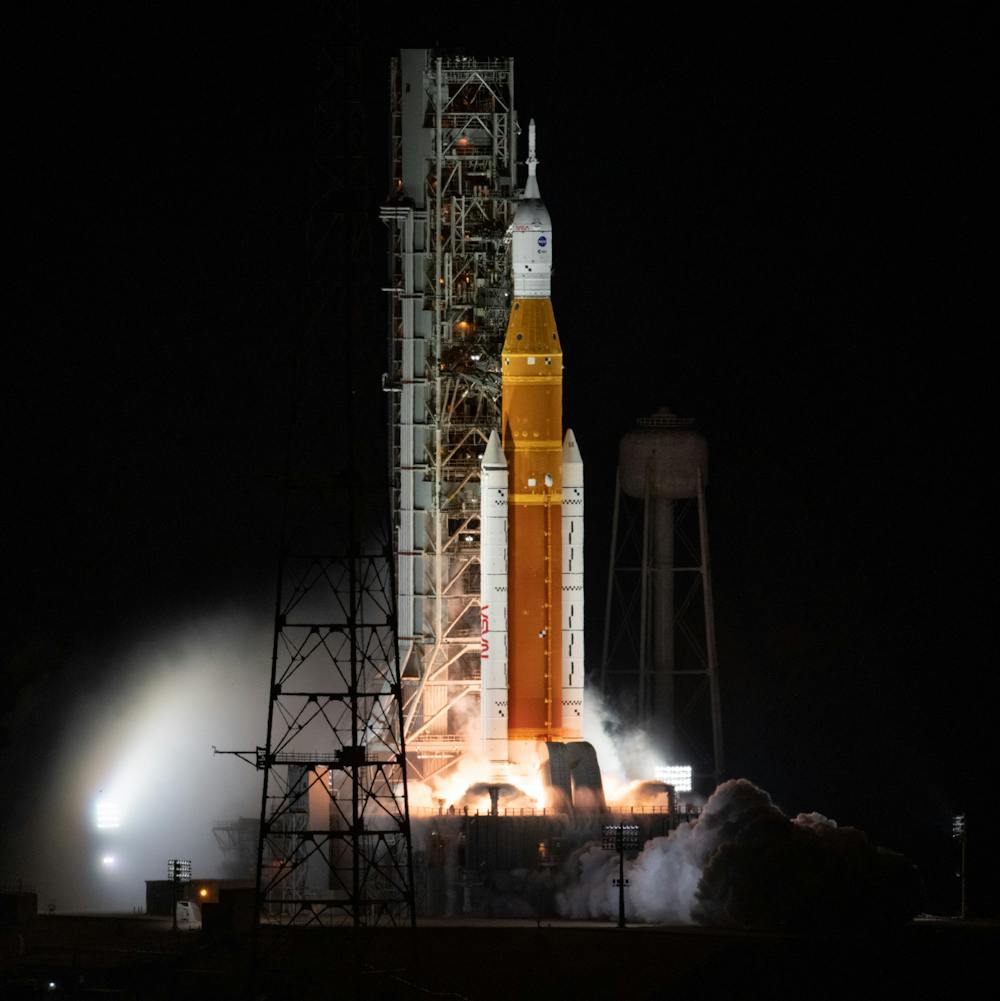
The Artemis II mission officially launched on the evening of April 1, from the Kennedy Space Center in Cape Canaveral, Florida, marking the first time humans have traveled beyond low Earth orbit since the Apollo program ended in 1972.
Lifted into space by NASA’s Space Launch System rocket, the Orion capsule carried four astronauts: Reid Wiseman, Victor Glover, Christina Koch and Jeremy Hansen, on a roughly 10-day mission around the moon, according to Reuters.
“The nation, and the world, has been waiting a long time to do this again,” said Wiseman, the Artemis II commander, according to The Guardian.
The primary goal of Artemis II was not to land on the Moon, but to test the systems that will eventually allow humans to return there safely as a part of future missions. After launching from Florida, the Orion spacecraft first entered Earth’s orbit before performing a key engine burn that propelled it toward the Moon.
This path, known as a “free-return trajectory,” allows the spacecraft to loop around the Moon and naturally return to Earth using its gravitational pull, which added on an extra layer of safety in case of emergencies or in the event of a system failure, according to Reuters.
During this phase, astronauts travelled farther from Earth than any humans in history, even exceeding the distance reached during the Apollo 13 mission.
The crew travelled 252,756 miles from Earth, according to NASA, which broke the record of 248,655 miles set by the Apollo 13, according to The Guardian.
The Apollo 13 mission became a rescue mission after an oxygen tank exploded in the Service Module, leading to the crew using the Lunar Module as a lifeboat, and splashing down in the Pacific Ocean, according to NASA.
While orbiting the Moon, the crew passed behind it, temporarily losing communication with Earth before reestablishing contact. This portion of the mission was planned and was especially important for testing navigation and communication systems in deep space.
Throughout the journey, the crew had actively been monitoring and testing life support, propulsion and onboard controls, while also capturing images and observations of Earth and the moon, according to Reuters.
These tests are critical for ensuring that future missions, like Artemis III later in the decade, can safely carry astronauts to the moon’s surface.
This final stage tested the spacecraft’s heat shield and recovery procedures, both of which are crucial for longer missions beyond Earth’s orbit.
The mission concluded with the Orion spacecraft splashing down at 8:07 p.m. ET on April 10, 2026, off the coast of San Diego, according to NASA.
Millions of people viewed the televised splashdown all around the world, with coverage from major networks like ABC, NBC and CNN, alongside official NASA feeds on YouTube and NASA+.
Following splashdown in the Pacific Ocean, the astronauts were recovered by a joint NASA and U.S. military team. They were helped out of the spacecraft while in open water and airlifted by helicopter to the USS John P. Murtha, where they underwent initial medical evaluations, according to NASA.
The Artemis II crew also shows how space exploration is becoming more diverse and global. Christina Koch became the first woman to travel this far into deep space, Victor Glover the first Black astronaut to go beyond low Earth orbit and Jeremy Hansen the first Canadian to join a lunar mission, according to Reuters.
Artemis II represents a significant step toward returning humans to the Moon. Although it was primarily a test mission, it played an essential role in ensuring that systems are reliable for future lunar landings.




.jpg)