By Joseph Caruso & Tyler Morello
Sports Editor & Staff Writer
The NBA Draft lottery has come and gone, and all eyes are now on the draft itself. The Signal’s sports staff is here to rank the 14 best players that will be selected by a team come the draft in June.
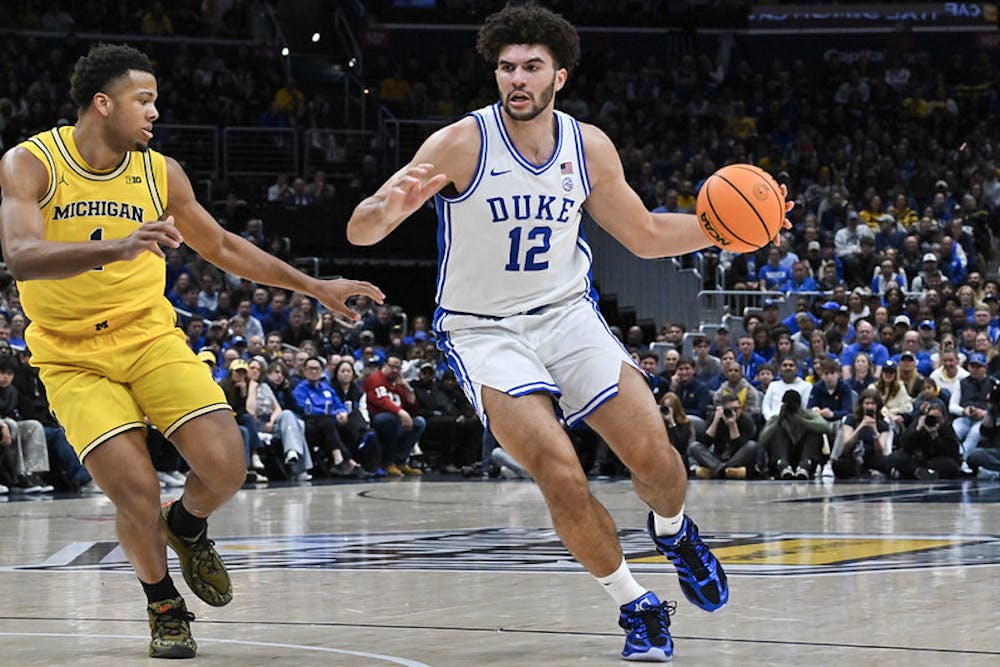
Cameron Boozer - Duke
Joe’s pick
The son of former bruising power forward Boozer, Cameron had the most productive season for a freshman in college basketball history, pairing 22.5 points and 10.2 rebounds with historic efficiency and impact metrics.
The 18-year-old forward is a bulldozer inside while shooting nearly 40% from beyond the arc, but his lack of “in-between game” (sacrificing efficiency for aura and hype moments) bothers fans and analysts enough to draw incorrect conclusions about his skillset at the next level. Wherever he is drafted, the team that selects him will have a franchise-changing player from the get-go.
Player comparison: Moses (the historical figure)
Darryn Peterson - Kansas
Tyler’s pick
Peterson came into the 2025-26 collegiate season as a freshman and sure-fire top-three prospect headlined by his absurd shot-making ability and great ancillary skillset that all NBA teams are looking for. While he very well still could end up a top three pick in the draft, he had multiple question marks left unanswered throughout the year, causing him to slide down many experts' boards. Peterson missed games for the Jayhawks and even left some games early with mysterious cramping issues.
Despite all of the talk at the time being about his motor and desire to compete, it does mean something that Peterson opted to play through the injuries rather than sitting out the rest of the season, which still would have guaranteed him to be a top pick. There also has been news coming out explaining that the cause of Peterson’s injuries were from taking creatine, and he has stopped taking it since training for the NBA Combine. His on-court play was up there with the best in the country, as Peterson averaged 20.2 points per game and over two stocks per game. He should also provide more playmaking impact at the professional level, as his 1.6 assists per game did not tell the whole story of his time in Kansas.
Player comparison: Lengthy Jamal Murray
Caleb Wilson - North Carolina
Joe’s pick
If you had only watched Wilson’s highlights, you’d probably have a hard time figuring out how he isn’t the consensus No. 1 ranked player on everyone’s board. 2 inches from being 7 feet tall, the former freshman Tar Heel used his freakish athleticism to put opposing defenders in the rim on the offensive side, while boasting perhaps the most promising defensive chops in the class due to his combination of size and skill, recording nearly three stocks per game this season.
Wilson still has room to grow on the offensive side, but remains one of the most league-ready players in the class, and will most likely find himself in the top three picks come June.
Player comparison: The Charmander to Kevin Garnett’s Charizard
A.J. Dybansta - Bringham Young
Tyler’s pick
Dybansta will most likely be the No. 1 overall pick in the draft. He is a 6-foot-9-inch uber athletic forward who averaged 25.5 points per game as a freshman in a very competitive conference. This by itself should garner him as the first overall pick. However, digging a little deeper into his profile does bring up some red flags that should not be ignored. Despite having this monstrous frame and athleticism, Dybansta’s defense and rebounding (especially offensive rebounding) were near nonexistent.
His scoring juice is certainly impressive, but his shot diet consists of taking more mid-range jumpers than rim finishes or 3-point attempts. It seems he isn’t using his elite size and ability to his advantage. If a team thinks they can coach these habits out of him and take him first overall, by all means, they can. However, it is definitely something teams should keep in mind when deciding between Dybansta and the other top prospects.
Player Comparison: Grant Hill minus the playmaking
Mikel Brown - Louisville
Joe’s pick
Brown has fluctuated more than any other pre-draft prospect due to lingering uncertainty about his health, specifically the back injury that caused him to miss the NCAA Tournament this past March. However, Brown claims he’s healthy, and the 6-foot-5-inch floor general has the highest ceiling of any point guard in this upcoming pool of players. Brown’s selling point is his top-of-the-line free throw rate and three point rate, which remain two monumental indicators of success at the next level.
The Louisville product had nine 20-point performances in his shortened freshman season, including a 45-point explosion against NC State, where he drilled 10 of 16 3-point attempts. Assuming he checks out physically, teams would be foolish to pass on Brown, who gives everything a team could want as a score-first guard.
Player comparison: Somewhere in between Anfernee Simons and Damian Lillard
Kingston Flemings - Houston
Tyler’s pick
Flemings faced sort of an uphill battle to begin his collegiate career as he was the third-highest recruit in a loaded Cougars group. A scorching start to the season put him near the top of draft boards, and he did finish top five in freshman Box Plus/Minus by season’s end with 11.4. Despite the incredible production from a freshman, Flemings is another case of his shot diet being suboptimal.
Only 23% of his shots came from beyond the arc, and while he did shoot over 38% from three, you ideally want your lead guards to be able to get off long-range shots when they can. The NBA Combine will be a good measure for teams to see how Flemings stands out amongst his peers.
Player Comparison: Sactown De’Aaron Fox
Dailyn Swain - Texas
Joe’s pick
Swain almost certainly won’t be selected nearly this high, but let’s make the case as to why he should. Swain fits the bill of the most coveted NBA archetype: a long, lengthy wing who can wreck a game defensively while also being a plus player on the offensive end.
The 20-year-old isn’t your typical “3&D” player, but leans into more of a point forward profile in the half court, while excelling in transition. Swain had a ridiculous season analytically, being 90th percentile or better in true shooting, free throw rate, as well as assisted and unassisted rim buckets. In my opinion, there is a misconception going around regarding Swain’s jump shooting making or breaking him, as he can very easily be an excellent pro even if the jumper doesn’t necessarily ever totally come around.
Player comparison: We have Franz Wagner at home
Keaton Wagler - Illinois
Tyler’s pick
The Fighting Illini team that made a Final Four run this year would not have been where they were without freshman guard Wagler’s unforeseen emergence. Wagler was an unranked high school prospect from a public school in Kansas, which prevented him from getting much national attention. He finished right behind Flemings in freshman BPM while standing at 6-foot-6-inches with a 6-foot-9-inch plus wingspan, but he doesn’t project to be as good defensively.
Wagler provides a lot of what NBA teams would want in one of their lead creators: three-point making ability and getting to the charity stripe. One interesting caveat with Wagler’s season was that he finished with zero (zero!!!) dunks on only one (one!!!) attempt. This is not the end of the world, however, it does draw athletic concerns being 6-foot-6-inch with no dunks.
Player comparison: Austin Reaves
Aday Mara - Michigan
Joe’s pick
The starting big of the National Championship winning Michigan Wolverines has undoubtedly been the biggest riser of the college basketball season, now frequently being mocked in the upper tier of the lottery, and it’s hard to abstain from rating him even higher. Towering over his peers at 7-foot-3-inches, Mara is one of those unique high-feel big men, who is superb at playmaking out of the post.
His reputation on the defensive side speaks for itself, flaunting a 12% block rate all the while anchoring the defense of one of the most dominant college basketball teams in history. Maybe the most impressive feat of Mara is the ability to play-make on defense while staying out of foul trouble, something that has plagued the likes of similar players.
Player comparison: Gigantized Isaiah Hartenstein
Yaxel Lendeborg - Michigan
Tyler’s pick
After testing the NBA draft waters last year following his senior year at the University of Alabama at Birmingham, Lendeborg decided to transfer to Michigan for a fifth year. Although he will almost certainly be the oldest player drafted this year, his production and versatility as the best player on the best team in the nation were undeniable. He stands at 6-foot-9-inches with a 7-foot-4-inch wingspan, which allows him to be more than capable of playing positions three through five, while even being a primary ballhandler at times.
His “upside” perhaps does not reach the peaks as some of the younger prospects, but possessing the tenth highest BPM in a single season ever for a college player means something. Lendeborg will be the ultimate Swiss Army knife for whatever team drafts him with their lottery pick.
Player comparison: Elderly Aaron Gordon
Allen Graves - Santa Clara
Joe’s pick
The analytical darling of this year's class, Graves jumps off the page in every statistical category. The 6-foot-9-inch forward shot 60% on twos, over 40% on threes, while possessing a silly 4.9% steal rate. Did I mention he is 99th percentile in offensive rebound percentage? Any skill you can think of, Graves is a master at it, and by the numbers, he projects as one of the top players in the draft. With that being said, it would be stunning to see the 19-year-old selected in the top 10 for a few reasons.
First and most importantly, he came off the bench for a West Coast Conference team, warranting questions about the level of competition he opposed. It would be pretty radical to select a player that highly that didn’t even start for a mid-major team. Regardless, Graves will most likely be a post-lottery steal as someone who immediately has a high-level impact for a contending team.
Player comparison: Boris Diaw with aura and a jumpshot
Morez Johnson Jr. - Michigan
Tyler’s pick
The third and likely final member of the National Champion Michigan Wolverines to get drafted in June, Morez Johnson Jr. was as consistent as big men come. His defensive presence is the selling point, as he is extremely mobile on the perimeter for his 6-foot-9-inch 250 pound frame, and can still protect the rim as a secondary shot blocker. Johnson Jr. started at the four next to Mara and Lendeborg for the Wolverines, but he may end up as more of a three/four at the next level.
There have also been noticeable jumps from his freshman to sophomore year as a connector and scorer, with his free-throw percentage jumping from 61.8% to 79.3%, and his assist percentage growing from 2.7% to 8.4%. He didn’t hit a single three pointer his freshman year but knocked down 34.3% of his limited attempts this season, with the 79.3% from free throw as a strong indicator that he is quite capable. We could also see Johnson Jr. slim down 10-15 pounds before his rookie season, which would allow him to play more as the modernized forwards the NBA has today.
Player comparison: Edrice “Bam” Adebayo
Ebuka Okorie - Stanford
Joe’s pick
A somewhat surprising member of the upcoming draft, Ebuka Okorie had a transcendent season at Stanford, averaging over 23 points per game as one of the best bucket-getters in the country. Similarly to Brown, Okorie excelled at firing threes and getting to the free throw line, being impossible to stay in front of in isolation. The 19-year-old is a bit of a wildcard, but could very easily pan out as the best guard in a questionable class at that position.
Player comparison: Modernized Steve Francis
Jayden Quaintance - Kentucky
Tyler’s pick
Quintance was coming off one of the most impressive age adjusted seasons in recent memory last year at Arizona State. As a reclassified freshman, Quaintance was 17-years-old averaging 9.4 points, 7.9 rebounds, 1.1 steals, and a whopping 2.6 blocks while playing less than 30 minutes per game. In late February of 2025, he suffered a torn ACL, cutting his fantastic freshman season short. Quaintance was the premier name in the transfer portal heading into the 2025-26 season and joined an exciting Kentucky Wildcats team that was poised for a deep run in March.
Unfortunately for Quaintance and the Wildcats, he was not able to fully recover during the year, as his knee issues flared up, causing him to only play in four games. If Quaintance’s physicals are clean and he is able to participate in on-court workouts ahead of the draft, he has a case to return top ten value, as he is still just 18-years-old.
Player comparison: Woke Mitchell Robinson
Notable omissions
Darius Acuff - Arkansas
Similar to Bailey of last cycle, Acuff is far and away the most polarizing player in this year's class, due to his flashy offensive game paired with his historically poor defensive profile. The Razorback is the next of several John Calipari coached guards to be highly-touted coming out of school, but he’s a little different than most that came from Kentucky.
Everybody is aware of Acuff’s offensive prowess, so why off the list entirely? Well, the 19-year-old does virtually nothing on the other side of the ball. Rebounding, stocks and his defensive BPM are worse than any other prospect in the history of college basketball. His lack of size and effort on that end make other small guards look like All-Defensive players.
Simply put, Acuff will have a difficult time contributing to a winning team unless he is one of the best offensive players in the entire league, let alone the draft class. Regardless, it’d be a surprise to see him fall outside the top seven on draft night.
Nate Ament - Tennessee
Let’s start with the positives: Ament is a 6-foot-10-inch wing. You’d be hard pressed to find strengths outside of that. As for everything else, he struggles scoring, averages more turnovers than assists, can’t shoot jumpshots and is an underwhelming defensive playmaker for someone who is his size. He’s being mocked in the top ten quite frequently, and if a rebuilding team selects him anywhere in or near the lottery, it will be a franchise-altering mistake.
Labaron Philon - Alabama
Philon returned to Alabama for his sophomore season, looking to produce outside the shadow of former superstar Mark Sears, and he did just that. The 6-foot-4-inch guard averaged 22 points a game while getting up an efficient 10 three point attempts. He improved in every aspect and will provide teams with more than just a spark off the bench as someone who has shown great flashes as a playmaker and should be a feisty defender in a scaled-down role.
In most other classes, Philon would be firmly in the top ten, but he’s going to make a general manager very happy if he slips past the lottery.