By Isabella McHugh
Nation & World Editor
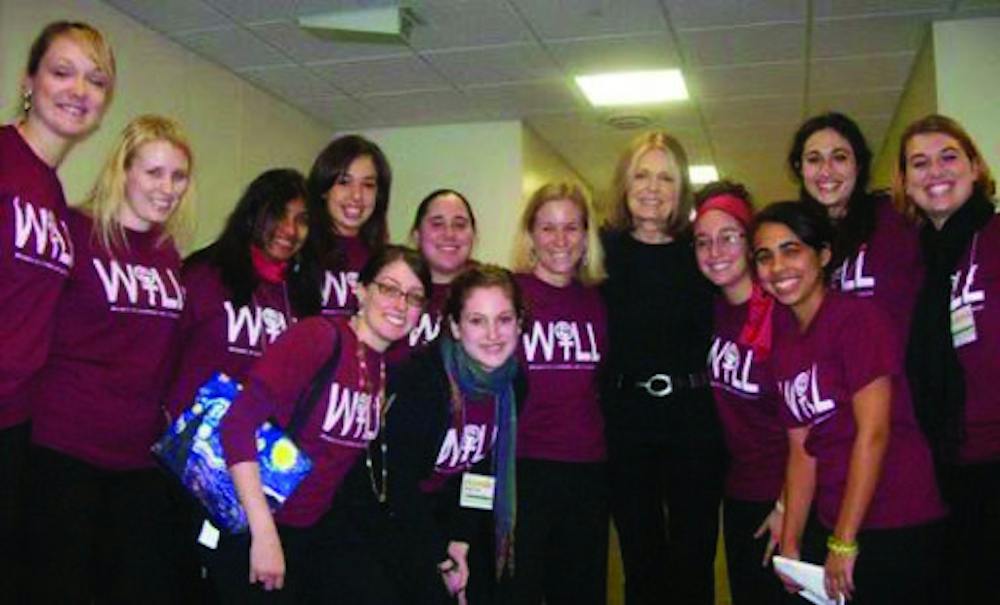
In the wake of American journalist and social activist Gloria Steinem’s recent passing, former students and a staff member shared their personal experience meeting her at the College during Women’s History Month in 2016.
“She was gentle, but powerful; she was mystical yet practical,” Jennie Sekanics, one of the College’s alumni said about Steinem back in 2016.
Sekanics emphasized how Steinem would always bring listeners back together and see a bigger picture regarding issues she discussed.
Cecilia Colbeth, current director of Women in Learning and Leadership said that Steinem spoke about her book which had recently been published at the time titled, “My Life on the Road.”
Steinem’s book detailed her experience traveling across the world and bringing about change while finding herself along the way. “My Life on the Road” is Steinem’s personal story of transformation into the woman she is remembered by to this day.
Rosie Driscoll, another one of the College’s alumni and former president of WILL, described her first encounter with Steinem’s work, Ms. Magazine.
Driscoll had a friend whose father worked in a New York City mail room. “He knew I loved to read, and so he would always give me stacks of extra magazines,” she said. “And one day, in the stack, was a copy of Ms. Magazine.”
Ms. Magazine is a national American feminist magazine designed to give voices to women and other marginalized groups. It was co-founded by Steinem and Dorothy Pitman Hughes in 1971, according to Ms. Magazine.
Driscoll described Ms. Magazine as her gateway to understanding what feminism actually was. She said the term ‘feminism’ “wasn't really a trendy thing back then.” Driscoll said she had not read about the term until around 2011 or 2012, but Steinem’s work helped shape her perspective even before meeting Steinem.
Sekanics was part of the WILL program in 2016, and interviewed Steinem when she visited the College.
During the visit, Sekanics said Steinem spoke about feminist issues like abortion healthcare, and menstruation which “has long been a source of shame” for many people.
Sekanics detailed a period of monologues in which everyone in the WILL program gathered together with Steinem to discuss how “menstruating creates opportunities of play, and weird, vulnerable conversations.”
Colbeth said that during Steinem’s visit, students held concerns about women’s healthcare, specifically abortion rights. “There was a little bit of trepidation of what would happen if the administration changed after the 2016 election, which it did,” Colbeth said.
Shrika Dogiparthi, a sophomore Economics and Women, Gender, & Sexuality Studies major and current WILL student believes that, “as a society, we are slightly coming to a regressive period, especially in the modern administration and the world of politics at the moment,” in terms of women’s healthcare.
This current state reflects the issues WILL students felt concerned about in 2016.
During her time at the College, Driscoll interned at Planned Parenthood Action Fund of New Jersey and learned how to organize volunteering and draw people to events rooted in activism in regards to reproductive health at the state level.
Sekanics said that even where she lives in Iowa the abortion laws are considered to be stricter than a state like New Jersey. “Abortion at the end of the day is a form of healthcare; I think one Planned Parenthood is still viable in the state of Iowa.”
Sekanics vividly remembered Steinem’s emphasis on interconnectedness. She described Steinem’s beautifully woven philosophy that what people do in one part of the world impacts issues and marginalized groups everywhere.
“With what's happening in Gaza, I think that there's a greater push to think transnationally.” Sekanics provided as an example. “And to think about how the sort of political experiences we have here are always sort of interconnected with atrocities that are happening in other spaces.”
Driscoll also brought up Steinem’s focus on interconnectedness as something that she carries from that event to this day. Steinem’s view supports the idea that feminism benefits everyone which include LGBTQ+ individuals, people of color, men and women. Driscoll believes that level of care and understanding are crucial to move forward as a society.
Colbeth said that Steinem took the time to really connect with students during the dinner and stayed past midnight, “because she was speaking to everybody individually, and I mean, it didn't matter who you were.”
Both alumni touched upon that sentiment, speaking highly of Steinem not only as a figure but as a person.
“She focused on tethering us back to each other,” Sekanics said. She continuously emphasized Steinem’s ability to make people feel as though they were part of something greater than themselves. Sekanics described the moments with Steinem as “really magical.”
Driscoll described Steinem as “lovely” and “calm” in a way that emanated dignity and confidence.
Steinem may have passed away, but her legacy continues to march forward.
“Feminists across the world are going to remember everything that she did, that she sacrificed and what she stood for,” Colbeth said.
Sekanics and Driscoll reflected on a singular question they would ask Steinem if she were alive today.
“I think what I'd want to ask her is, what are we not doing that you think the feminist movement needs today?” Driscoll said.
Sekanics would challenge Steinem’s idea that the voting booth is the one place where everyone is equal.
She paused for a moment before saying, “I would ask her if she still believes that the voting booth is the place where the most powerful and the least powerful are equal.”
Sekanics brought up recent concerns such as the legislation proposed for people who changed their name, and their hindrance in the voting process. She explained that this targets married women who changed their last name and transgender individuals.
Dogiparthi praised Steinem’s push for “equity and equality,” and all the wonderful things she accomplished in her life which subsequently contributed to the WILL program.
She said, “I think that Gloria Steinem's morals and message definitely live on within the WILL program, and I'm just so grateful, and I know all the other girls are so grateful for everything that she's done for us.”