By Emily Lindsey
Correspondent
Bangladesh has recorded over 166,000 suspected measles cases since March of this year, designating the country as the current largest measles outbreak site in the world, and leaving global experts wondering how the virus has avoided containment.
According to the Associated Press, by Sept. 8, “the death toll from suspected measles cases reached 999 since the start of the year.”
The rapid growth of the highly contagious virus was mostly due to “sustained domestic transmission” both via particles in air and droplets from an infected person’s mouth, nose or throat, according to the World Health Organization.
Their organization “recommends the conduct of mass immunization campaigns as an effective strategy for delivering vaccination to children who may have been missed by routine services,” as the disease can be most serious, and even fatal for young children.
According to the World Health Organization’s divisional coordinator for Dhaka, Bangladesh’s capital city, “Even small gaps in immunization coverage can trigger outbreaks. Every missed child increases the risk.”
However, the lapse in vaccinations from 2024 to 2025 that led to such a catastrophic consequence was not primarily caused by a health crisis. Reuters reported that the main culprit was an uptick in “political turmoil after a deadly uprising against then prime minister Sheikh Hasina.”
After Hasina was removed from office, “interim leader Muhammad Yunus left the country with shortages of vaccines and far behind on coverage,” the Associated Press reported.
In the pursuit of reforming the government structure, the country had neglected the 2024 vaccination campaign. Combined with public hesitation to vaccinate young children during the COVID-19 pandemic, conditions in Bangladesh were set for a major outbreak.
One month after the initial outbreak in March, “the country’s health minister, Sardar Md. Sakhawat Husain, offered this assessment: ‘Measles outbreak has somewhat decreased in the country. Once the nationwide vaccination campaign begins on April 20, the situation will improve further,’” NPR reported.
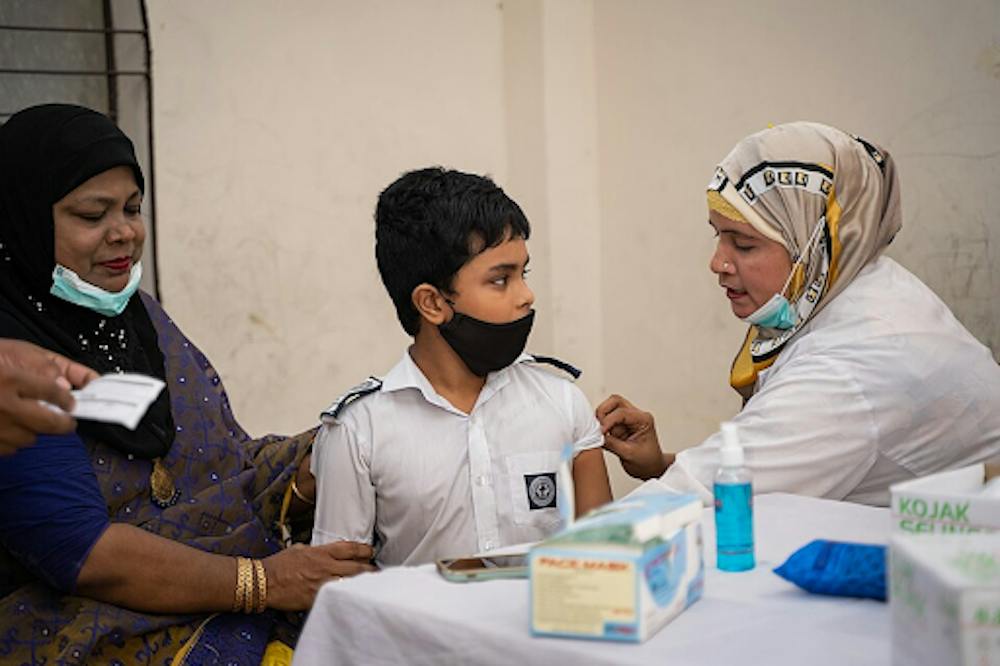
The vaccination campaign included over 18 million vaccinations and concentrated on children’s vaccines, as Reuters reports that “under-fives accounted for about 80% of cases during the early stages of the disease's spread.”
Even though the campaign met its goal handily, NPR undercuts that 18 million vaccinations were not enough. “Health experts in the country now say that 22.6 million is the true target.” To address this discrepancy, the government offered its final 1.6 million vaccinations for young children on Aug. 18.
Still, as the vaccinations trickle in, the country is worn thin with the constancy of the outbreak. According to Reuters, one state-run hospital in Dhaka called Shaheed Suhrawardy Medical College Hospital is treating patients on the floor to accommodate 1,000 patients over their capacity.
Bangladesh will need to be methodical in its implementation of immunization tactics. According to the Associated Press, “Two doses of a vaccine provide strong protection against measles, but the WHO says 95% of the population has to be vaccinated in order to stop the disease from spreading.”
The widespread permeation of malnutrition in children across Bangladesh increases their risk of contracting measles and their risk of death after contracting it. Not only that, but malnutrition decreases the efficiency of vaccines in affected children.
Immunization will be a long, arduous process, but Bangladesh has shown that it is possible through its management of epidemics that affect mothers and young children like measles, tuberculosis, and more.
“Between 2021 and 2025, the country recorded just 100 to 300 cases per year, down from 2,410 cases in 2020,” according to The Associated Press.
Recovery is possible, and according to NPR, the Bangladeshian government is preparing itself by utilizing the help of UNICEF to stockpile 2.5 million vaccines for future shortages. With sustained support from world health organizations, some experts have hopes that Bangladesh will improve its documented cases of measles within three months.