By Tasnim Oyshi
Editorialist
All federally funded colleges in the United States are covered by Title IX, a law that essentially forbids discrimination on the basis of sex. Title IX is also supposed to protect students who have been victims of sexual violence during their time at the school. In light of the recent lawsuit against Cornell University, the current protections under Title IX raise ethical questions.
On Sept. 14, a former Cornell student, known only as Jane Doe, filed a lawsuit against seven current and former Cornell students for allegations of drugging and gang rape. The students were Matthew Ingalls, Johnathan Newell, Winston Lee, Gillio Lopes, Diego Sarabia, Scott Norris and Scott Kretzschmar.
The university and Chi Phi fraternity chapter were also sued, of which the seven male students were members. Additional defendants include the former president of the chapter, multiple sororities, a local bar that allegedly overserved Jane Doe along with other Cornell alumni and faculty.
The lawsuit accuses the seven men of an alleged 2024 incident at the Chi Phi fraternity’s house, where the plaintiff met up with her friend and one of the defendants, Ingalls, on Oct. 19, 2024 at about 11 p.m. There, defendants Ingalls and Jonathan Newell allegedly sexually assaulted her.
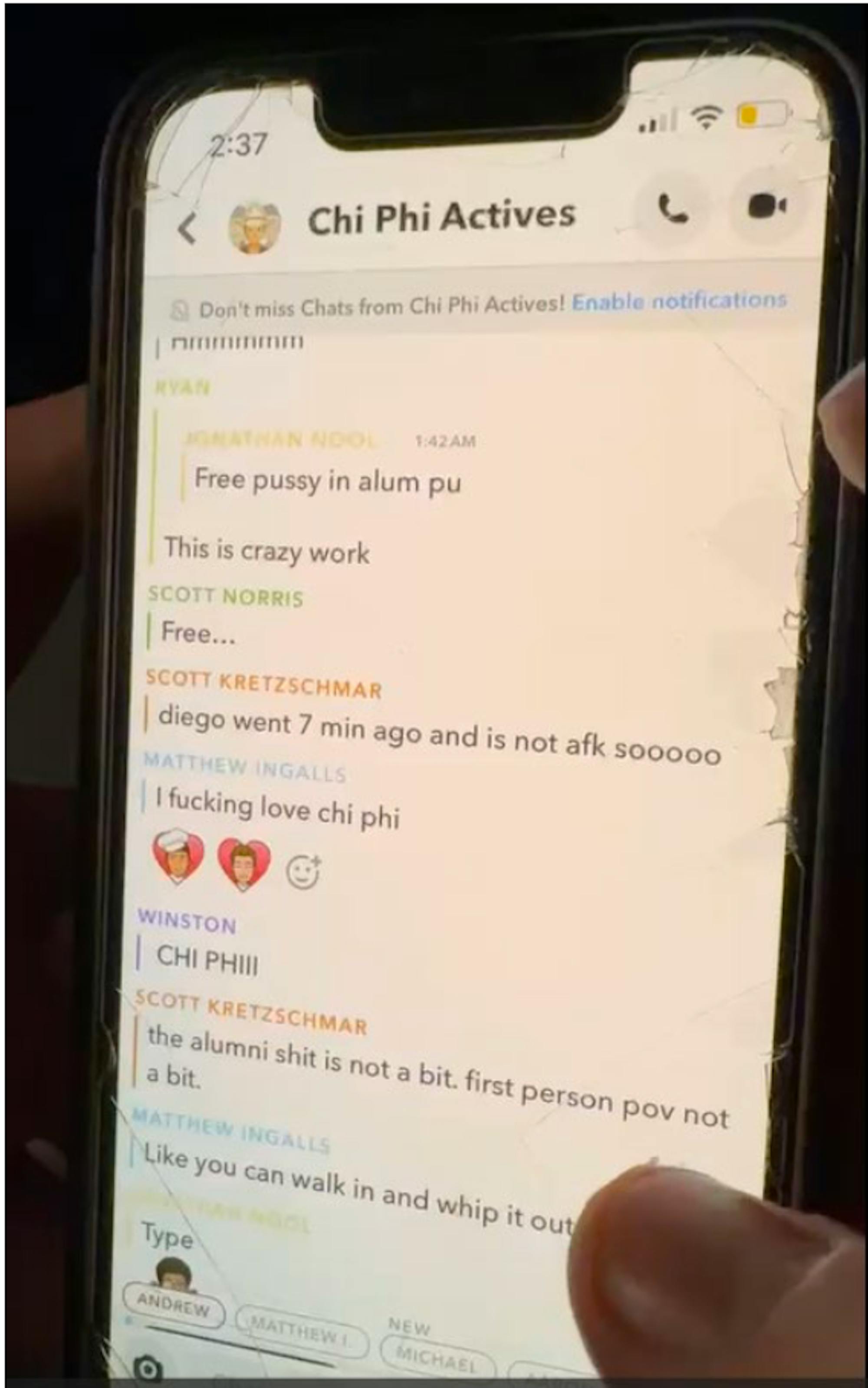
A screenshot from page 27 of the lawsuit shows a Snapchat group chat of Chi Phi members, where Newell invited other members to join with the message, “Free p***y in alum pu,” at around 1:42 a.m. Several members joined and the assault continued until about 5:45 a.m., the lawsuit states.
When the plaintiff reported them to the Cornell University Police Department on Nov. 8, 2024, the school put the fraternity on “temporary suspension for alleged violations of the Student Code of Conduct,” according to The Cornell Daily Sun, Cornell’s student newspaper.
The seven defendants were also temporarily suspended. Around Jan. 14, 2025, Cornell launched a Title IX investigation, resulting in at least 12 hearings in May 2025. “Upon information and belief, Cornell’s Title IX investigation is concluded,” the lawsuit states.
The Cornell Daily Sun was one of the first to break the news of the lawsuit. In the same issue, they published an accompanying editorial titled, “Cornell Won’t, We Will,” that began with the names of the defendants.
The editorial board criticized how long the university took to conduct an investigation and the lack of disclosure regarding the consequences the defendants received. One particularly contentious point in the lawsuit was that the seven were given the chance to submit essays as recompense for the alleged assault.
According to a Sept. 28 statement from Cornell, “At its conclusion, the hearing panel issued a range of sanctions, which included expulsions and suspensions from Cornell. None of the individuals charged were offered the opportunity to write essays as a sole consequence of their involvement.”
What allegedly happened to the plaintiff is, without a doubt, horrifying and life-altering. As per the intentions of Title IX, it is Cornell’s job to provide her with the support she needs after the fact and thoroughly investigate the accused. Cornell maintains that they were thorough.
This was not clearly communicated to their students and certainly not The Cornell Daily Sun, who had to take it upon themselves to publish the names of the defendants. The way Cornell handled this situation can be debated in several ways and definitely has been if you look at social media discourse.
The important question, however, is if Cornell truly did their job based on Title IX or if Title IX itself is flawed in its protection of sexual assault victims. While Title IX investigations typically conceal the identities of the accused and victim, there is no specific rule about what can be revealed once the investigation is done.
Perhaps, Title IX should have a specific policy on what should and should not be shared with the public after an investigation. Maybe Title IX could also use stronger and clearer rules about how to conduct sexual violence investigations.
As of Sept. 28, New York prosecutors have decided to reopen the case, according to ABC News. The same day, the Department of Education decided to rescind “a 2024 Title IX rule…that required schools to move proactively on sexual assault harassment cases, calling on them to strengthen and specify their protections for campus survivors,” stated The New Republic.
The timing of this news is unfortunate and concerning. Weakening a law that already has unclear policies leaves students unprotected and no place to turn if they face situations like the one at Cornell. Colleges should give students the opportunity to receive education without having to worry about their safety and Title IX should enforce that responsibility.