

By Isabella McHugh
Nation & World Editor
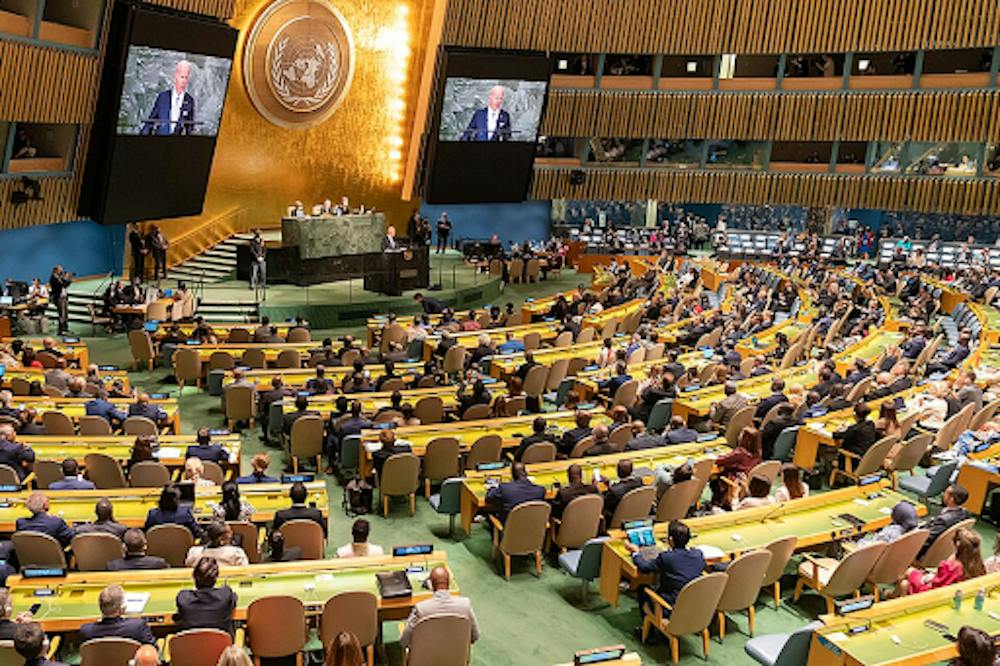
World leaders amassed in New York City where the annual United Nations General Assembly High Level debate took place between Sept. 22 and Sept. 28, CNBC reported. Here’s what you need to know.
Day 1
President Luiz Inácio Lula da Silva spoke first on Sept. 22, following the long-standing tradition that Brazil always speaks first, Aljazeera reported. President Donald Trump spoke after representing the host country.
“I can report to you with pride that America is back, and our country is stronger today than ever before,” Trump said among his other opening sentiments, according to the United Nations Web TV. He highlighted issues such as border security and crime rates, while consistently telling everyone that he turned the United States into “the most powerful country in the world.”
Not long after, Trump spoke about the U.S.' action against Iran and threatened to “annihilate” Iran if the countries didn’t reach a peace deal.
Day 2
The U.N. debate unfolded into talks of worldwide conflict and security on Sept. 23. Argentina’s President Javier Milei believes that the U.N. is not doing enough to guarantee collective security, the United Nations News reported.
World leaders gave attention to the Russia-Ukraine war, which arguably threatened regional security and global resources.
President Volodymyr Zelenskyy emphasized the importance of ending the war, standing by the conviction that Russian President Vladimir Putin is the determining factor. He stressed that Russia has consequently suffered the loss by death or severe injury of nearly 250,000 troops.
Zelenskyy also mentioned additional repercussions in other countries. “A war that was not prevented in time, was not stopped in time, and for which Russia was not punished in time, keeps spreading and spreads evil with it,” he said. He additionally stated, “The more freedom Putin has to act, the more dangerous the world becomes for everyone else.”
Zelenskyy discouraged intensive trade with Russia as he said this was fueling the war by giving Russia more means to sustain their resources.
Day 3
The Israel-Palestine war took precedence on Sept. 24 of the General Assembly’s discussion, according to the United Nations News. World leaders expressed concern for the effect it would have on food and security in many areas.
Palestinian President Mahmoud Abbas said the war in Gaza was a “Genocidal War” that brought about incomprehensible tragedy.
Contrarily, Israeli Prime Minister Benjamin Netanyahu accused the media of overlooking Palestinian attacks.
Comoros President Azali Assoumani discussed the resource instability, especially with food that suffered due to constant interference with the Strait of Hormuz.
Day 4
The U.N. debate switched to discussions about the climate crisis on Sept. 25. Small island states highlighted the fact that climate change is something the world is experiencing currently, and is no longer a faraway issue, according to The United Nations.
Saint Lucia’s Prime Minister Philip J. Pierre said that climate change threatens economic stability and security. “Climate finance is not charity,” he said.
Mauritius called for the implementation of the High Seas Treaty which is designed to protect ocean life as well as manage and share resources.
Day 5
On Sept. 26, the debate progressed to discussions about AI and the role it plays in the future. China’s Vice President Han Zheng argued that it should be used “for the positive and for good,” the United Nations reported.
Singapore’s Foreign Minister Vivian Balakrishnan expressed the need for safeguard investments. He said, “human beings must remain in control and accountable.”
Germany’s Foreign Minister Johann Wadephul added to the discussion of responsible AI usage, saying that AI can be a source for good to help humanity but could destroy economy and civilian life if it falls into the wrong hands or is used without regard for the rest of the world.
Day 6
During the final day of the debate, the U.N. reflected on the issues presented over the past several days.
The General Assembly President Khalilur Rahman reiterated issues like sustainability, saying that more should have been done to stay on track with their goals.
He also pointed out the hidden voices within the Assembly that were also some of the most affected by global issues.
Rahman spoke about minority groups, and the importance of making sure their voices are heard, and once again brought up the growing presence of AI.
As of Sept. 28, the General debate is concluded, but the General Assembly session is still underway from Oct. 1 until December where the U.N. will delve deeper into the issues discussed in the General debate and others that arise.
In closing the debate, Rahman said “This is only the beginning of the session.”



.jpg)