

By Emily Lindsey
Correspondent
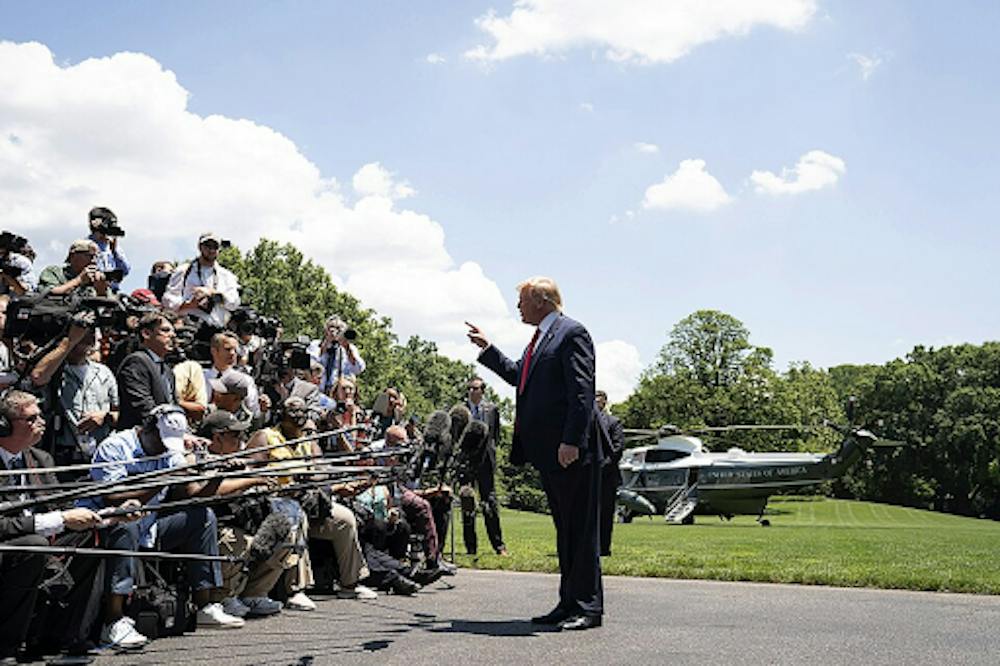
A security guard at a media checkpoint near the West Wing confiscated CNN correspondent Betsey Klein’s White House issued badge and denied her entry on Sept. 19, according to The New York Times. His only explanation was to refer her to the White House Press Office.
On Sept. 21, The White House formally announced that “President Donald J. Trump removed CNN, MS NOW, and Politico from the White House grounds after years of false reporting.”
All three news outlets were quick to respond with a lawsuit. The Associated Press reported their joint lawsuit asserted that the Constitution “does not allow a president or any other government official to deprive the press of their First Amendment rights and liberty and property interests with no notice or process based solely on his dislike of the content of their reporting.”
The White House, however, maintained that while “the First Amendment protects their right to publish; it does not entitle them to a hard pass, briefing room seat, or place in the press pool.”
While all three outlets were excluded from the first two items in the White House’s list of privileges, The Associated Press reported that CNN's removal from the press pool that it shares with five other networks prevented them from covering events that the president attended outside of the White House.
“CNN had been scheduled to cover Trump's trip to New York for the General Assembly on Monday, but was not able to provide a pool feed,” according to Reuters.
In solidarity, The Associated Press “joined a number of news organizations, including The Washington Post and The New York Times, in a decision not to publish photographs of presidential events on Monday.”
In the midst of these major global events, Reuters reported that U.S. District Judge Tom Kelly, appointed by President Trump in his previous term, decided that “the revocation of the White House credentials of the journalists ‘likely violated their constitutional due process rights.’"
CNN itself argued that Judge Kelly's decision aligned with his ruling in 2017 to override a previous Trump White House ban on CNN reporter Jim Acosta. When Judge Kelly announced his decision then, he relied “on a 1977 precedent establishing that press pass holders were entitled to due process before their White House access was yanked.”
The New York Times elaborated that his current ruling included a two week lift of the enforcement of the ban, and Kelly instructed The White House to “‘immediately return, reinstate, and restore’ the press credentials held by employees of the three outlets.”
However, according to Reuters, when the banned outlets arrived at the White House on Thursday morning, all three were independently denied entry.
The Hill reported that “journalists working for the outlets were not allowed back onto the White House grounds until after noon Thursday.”
So, when President of China Xi Jinping and his wife Madam Peng arrived at the White House early that morning for a meeting that Trump described on Truth Social as “made for television,” not a single U.S. camera documented it.
Although the three banned outlets’ prosecution attorney Theodore Boutrous described the judge’s decision to CNN as “a strong ruling vindicating freedom of the press, due process and the rule of law,” The New York Times contended that the ruling “is a temporary reprieve for the three outlets while the litigation proceeds.”


.jpg)