
By Natalia Tomczak
News Editor
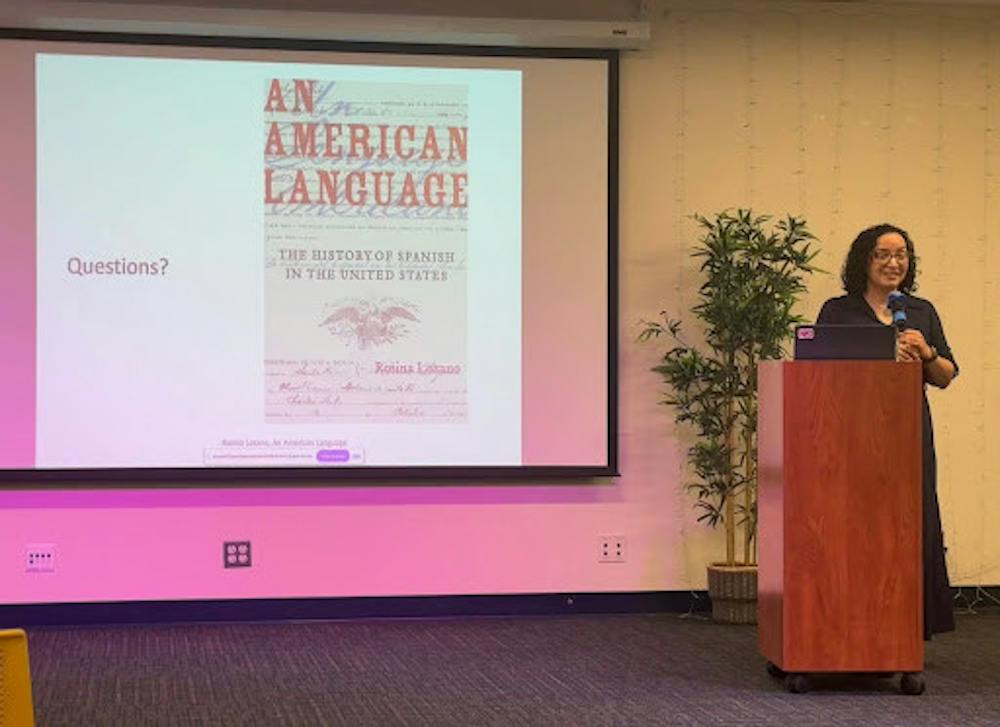
The College hosted Rosina Lozano, associate professor of history at Princeton University, to speak on her book, “An American Language: The History of Spanish in the United States” on Oct. 12. Lozano’s book has received the PROSE award in Language and Linguistics and the First Book Prize from the Immigration and Ethnic History Society.
She is currently working on another book, tentatively called “Intertwined Roots: Mexican Americans and Native Americans in the Southwest,” about the relationship between these two groups.
She began her presentation by highlighting that, while she will mostly be focusing on the Southwest region, particularly New Mexico, there is a history of Spanish language in various regions of the United States. In the Southwest, many city names come from the Spanish language and have remained, relating back to the era when Mexican land was ceded to the United States in different stages.
North America used to look quite different, until Mexico lost half of their land to the United States. With the treaty of Guadalupe Hidalgo ending the War in 1848, the first group of about 100,000 Mexican Americans was created.
They were promised property, liberty and religious rights – but not language rights. Nevertheless, this treaty has been used to fight for language rights due to its inextricable tie to the other rights listed there.
The first part of Lozano’s book focuses on how Spanish was “a language of politics” after the Mexican-American war. Many elite Mexican Americans were uninterested or unconfident with English, but in regards to politics, learning English brought more opportunities.
For example, Jose Francisco Chavez had the ability to give speeches in both English and Spanish, and he became a respected politician. Lozano explained how his father said, “‘The heretics are going to overrun this country. Go and learn their language, and come back prepared to defend your people.’” His skill was imperative in New Mexico, where most people did not speak English.
With a large population almost exclusively speaking the Spanish language, Spanish became “a language of politics” for the United States.
The second part of her book then delves into how Spanish becomes a political language.
Lozano speaks to this shift in perception, saying, “Spanish is often seen as an immigrant language, not as a language of the space that we’re in or of the U.S. in general. I always get asked, what do people think of your book title being ‘An American Language’ and having Spanish be part of it? And the truth is, I've never really been pushed back on it, and it's partly, I think, because I show so many primary sources. It has a long history, but at the same time, it’s not known.”
There are a few things that cause this transition. For one, in 1898, the outcome of the Spanish-American War shifted the use of the Spanish language in the United States as Puerto Rico was added as a territory; one million Puerto Ricans were added to the population. The United States then had to pay for translations.
At the same time, Cuba became a protectorate of the United States. Additionally, elite Filipinos had been part of the Spanish colonial system and spoke the Spanish language, so the United States used Spanish there.
Another factor was agriculture, and the passage of the Newlands Reclamation Act in 1902 which brought irrigation to the West. With the 1882 Chinese Exclusion Act and 1907 Gentleman’s Agreement, the traditional laborers were prevented from working in the United States, so they began to look south.
As a result, Mexicans were viewed as desirable laborers because they could go back and forth across the border.
“They could be pushed out when they weren’t wanted, and they could be brought back in and recruited when they were needed,” explained Lozano.
All of the sudden, this population was viewed as foreign and not as citizens, which was different to how the Spanish-speaking population was viewed in the Southwest before.
At this same time, Senator Albert J. Beveridge, who assessed whether New Mexico should be made a state, decided that because the population predominantly spoke Spanish they should not be made a part of the United States.
This idea of there being one American language, English, was part of the movement of Americanization, while at the same time there was a push for Pan-Americanism.
Lozano ended her presentation by offering some flashpoints in American history where the language splatters into even more directions.
Dennis Chavez, who was the senator in New Mexico for 27 years, advocated for everyone to learn English when they start school. At the same time in 1941, he helped bring into passage a law in New Mexico that brought Spanish back to school once students hit middle school.
To understand the social and economic conditions in Puerto Rico, he visited the territory and argued that they needed to learn English if they wanted to be part of the economy. It didn't go over well with Puerto Ricans.
The language was “really tied to Puerto Rico, with Puerto Ricans seeing the language as being part of their anti-colonialism, part of their own patriotism and part of their nationalism,” said Lozano.
Later during the Civil Rights era, during the East L.A. walkouts, high school students pushed for bilingualism in their classrooms. They wanted their teachers to speak Spanish, be bicultural and understand what was going on with the Spanish language.
Students walked away with knowledge that enhanced their understanding of history.
Joelle DuFault, alum of the College’s English Master’s program, noted, “I study a lot of contemporary Latin American gothic novels, and one of the big components is linguistic justice, or language based justice, which often occurs with these characters reclaiming Spanish, so it was really wonderful to hear the history that these books are talking about.”
Allison Silver, current English MA student, added, “I think it’s really interesting to think about translation and considering – beyond novels – what gets translated and what doesn't get translated.”
Lozano concluded by speaking briefly about New Jersey, saying, “One of the cool things about New Jersey is that the Latino population is so diverse. So this is a really interesting space to study because the population really includes everyone from all parts of Latin America and the Caribbean, whereas in other spaces, it really is kind of monolithic in some ways.”
When asked about her prognosis for the acceptance of Spanish in the United States, Lozano responded, “It’s a really hard question to answer, especially with the current administration shifting things so quickly. But I think language is very local, and so what you see at a local level is going to be very different depending on where you're visiting. “
On a federal scale, she adds, “The one thing that hasn't shifted is the Voting Rights Act of 1975, which allowed for the Spanish language to be one of several languages that are on translations for the ballot for federal elections. That law is still in place, at least through 2030, and it’s been extended multiple times since ‘76.”
“It'll be interesting to see if that continues to be something that is extended moving forward,” she concluded, on an uncertain note.