By Sky Pinkett
Features Editor
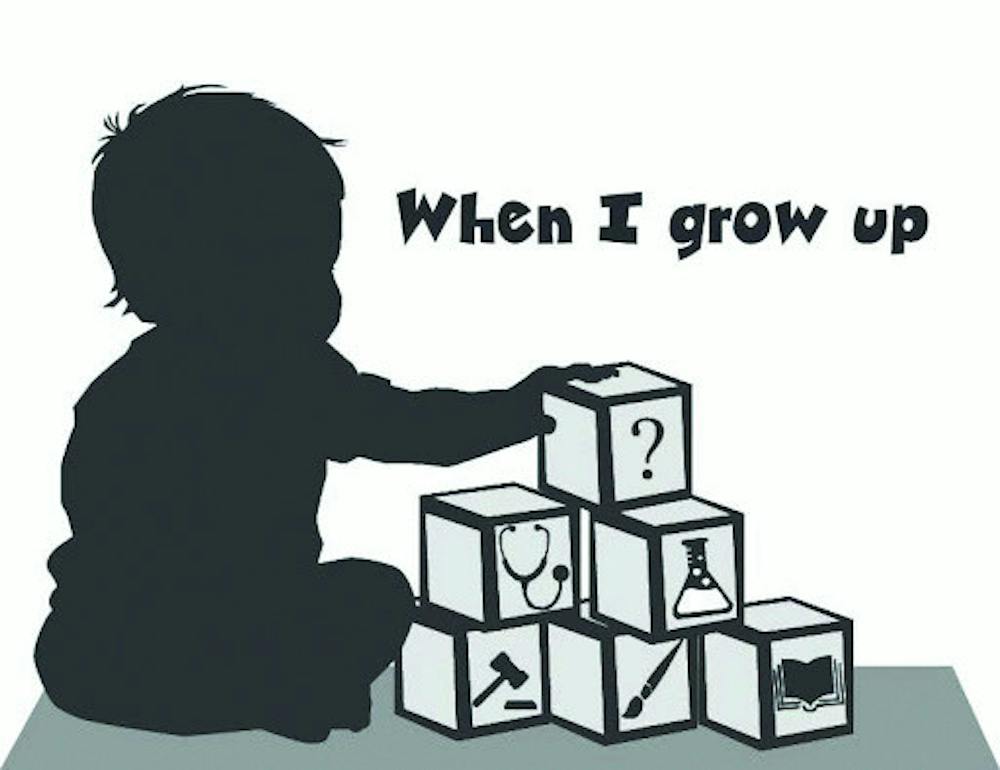
Around 80% of college students change their major at least once, with the average professional changing careers at least five to seven times in their working life. When I Grow Up is an academic spotlight series that digs deep into the majors offered at the College. It details opportunities, future job prospects, testimonials from students and professors and how a major may be a good fit for you.
“Have you ever walked around campus and thought about, “Huh, I wonder why those two squirrels are running at each other and look like they're playing? Have you ever looked at the side of a tree and noticed this green stuff on it? Have you ever been in your bathroom and you saw that little pink film that goes in the corner near the drain of a bathtub? Have you ever thought about the plaque on your teeth and how you can feel them?”
If the answer to any of these questions is an enthusiastic “Yes! Tell me more,” biology might be just the degree for you according to Kevin Dillon, one of the College’s biology professors.
“Pretty much any topic or anything that you can think of in your daily life, you can probably throw biology in there in some way.” Dillon said. “You can either talk about some type of animal interaction or you can talk about some type of tiny bacterium. You just think about anything in life and how they interact with each other. That's what you would study here in the biology department.”
From medicine to conservation, ecology, zoology, dentistry, research, forensics and even journalism, law, teaching and more — the possibilities that a biology degree offers are truly endless according to the College’s biology degree website.
“I'm a microbiologist, so I will always focus on that stuff,” Dillon said. “We have a new professor here who's more of a developmental biology and neurobiology person interested in certain proteins that have a correlation with autism. We have people here that work on birds…So, it's very exciting that we have such a diverse offering of opportunities for students, and we all work together to try to give our students the best education that they can get.”
For those interested in biology but unsure of what they want to do with it, the program starts everyone out with the fundamentals in addition to the College Core.
“All of our bio students have a core curriculum that they have to take, so we have four foundational courses,” said Wendy Clement, chair of the biology department. “And then, like many biology programs, you also need some training in math and in chemistry and in physics. So in the first couple of years, students are working on building that foundation. Then in the upper-level curriculum, sort of our 300 and 400-level classes that are on a range of topics, they're better prepared to take a deep dive into many of those different areas.”
Students can choose to minor in biology or pursue certain specializations in molecular biology, cell biology and genetics or in ecology, evolution and biodiversity.
“You can have a BS degree or a BA degree,” Dillon said. “The BS just requires more very specific science courses and is like the quote-unquote traditional route that a lot of people have done to go on to some type of graduate education or some type of medical-focused career.”
According to the U.S. Bureau of Labor Statistics, 70% of workers in biology-related fields required a bachelor’s degree, while 59% of workers in biology-related fields had an advanced degree in 2023.
“The BA allows you to be more flexible,” Dillon continued. “Maybe you have other interests outside of biology, but you still want to be a bio major. The sequence of courses in the BA allows you to take other courses, like if you also wanted to take a number of different English courses [for example]. And you can hopefully incorporate biology in some other discipline that you can study within the college.”
Students within the department are taking full advantage of the opportunity to integrate other disciplines with biology, like junior biology student Elena Sretenović, who was able to add a major in computer science.
“I saw another side of biology that had a lot of potential, because a lot of people were not going into it, but it was a burgeoning field and that was computer science,” Sretenović said. “So I thought, okay, maybe I can combine biology and computer science and go into the field of bioinformatics. So I came in with biology, and I found a lab that was interested in computational stuff that was related to plants, which I was very interested in. And I saw that there was a potential to go to conferences which immediately hooked me.”
There are a multitude of ways that students can mix and match other interests with biology.
“There are people who, for example, do a double major in art and biology. One person in my lab did that, and she now does science illustration because that's something that's very much in demand,” Sretenović said. “There are people who go on to do science communication, so they combine writing and science. You can combine biology with math and go into the field of biomathematics. You can combine it with chemistry, looking at maybe secondary metabolites that cells produce.”
The opportunity to combine other fields with biology opens students up to even more career prospects in the future. Areas in education, management, health, business and more are possibilities for biology students.
The question is, how does the College uniquely prepare students for their careers versus other universities?
“TCNJ really puts a strong emphasis on giving undergraduate students the chance to do research and I love that,” Dillon said. “That's what I want to do with students and that was a major reason for me coming here. We have a lot of great facilities for our labs that allow us to work with our students and get them exposed to brand new techniques that we can teach them in their typical lab classes, but also we implement them in our research labs where the students can delve into what it really means to do science and how to really go about asking a question, following that scientific method that you always hear about.”
“Across TCNJ, there's a really close communication with professors and students. We have small class sizes, and professors are really getting to know their students,” Clement added. “And I think one of the other things that makes our department pretty unique is the equipment and facilities that we have, like a state-of-the-art scanning electron microscope that some of our students are trained to use [and] a high-performance computing center that are able to analyze big data sets that take up more space and time than a laptop can possibly manage.”
Students like Sretenović feel the benefits of the small class sizes and research opportunities.
“TCNJ's biggest plus for the biology department is the ease of getting research and I feel like there's no place I'd rather have started my research,” Sretenović said. “There's a lot of amazing professors who have been teaching for a long time, so they know the ins and outs of everything. It is genuinely good teaching. I go there, and it's not like, oh, I wish I didn't wake up for this at 8am. I feel like I'm getting something out of it. They have a good amount of office hours and they're so helpful. I've always felt very much supported in every way by my professors.”
The research Sretenović experienced at the College prepared her to intern at the University of Pennsylvania this past summer to engage in advanced research, and she attributes that opportunity to her professors and the College.
“I have a lot of people in the biology department that I know they're recommending me for certain experiences. All of the skills and the knowledge I've learned, I think that's really set me up for success. That is the reason why I got my internship this summer, and I think it's really going to help me when I'm applying to grad school,” she said.
The support from the biology department doesn’t end once students graduate from the College.
“We have a lot of students after they graduate that are still in touch with us, letting us know what's happening, asking for letters of recommendation, and we're happy to continue to support students,” Clement said.
Support is also available for students who wish to start out as a biology major or switch to it as an established student here at the College.
“Any student on campus interested in changing a major, go talk to the chair,” Clement, being the chair herself, said. “I get emails all the time from students who are interested in changing their major to biology, and usually we start with a meeting. The other piece of advice I would give is that you do have to think about your math. If you never took a math placement test or haven't taken any math, that is something that you definitely have to do.”
For those who just felt their biology aspirations dwindle a little bit at the word “math,” professors like Dillon urge you not to be so quick to give up.
“People might have this misconception that STEM is exceptionally hard, but every major has its own things,” Dillon said. “So don't immediately go into it with a ‘oh, it's going to be so hard’ type of an attitude. When you decide to become a biology major, do not lose sight of why you wanted to do it in the first place.”
Sretenović, who can relate to the challenges that the biology major can bring, urges others to stay curious.
“If you were curious as a kid, always poking around in the forest or in the dirt, looking for things and wanting to know more, then biology is for you,” she said. “Take a biology class. That's where you learn to translate your curiosity into concrete biological questions. [Also] look through the biology professors' research sites and see if there's anything that piques your interest.”
All information related to salaries and job outlooks for occupations within the biology field can be found on the U.S. Bureau of Labor Statistics website, and visit the College’s website to learn more about what the biology program offers.