By Isabella McHugh
Staff Writer
Emily Brontë’s classic gothic tale of obsession and vengeance, set in the windy Yorkshire moors, has structurally metamorphosed into the most recent cinematic adaptation (and sensation, might I add) of “Wuthering Heights.”
To the moviegoer who has not immersed themself in Brontë’s multifaceted narrative, Emerald Fennell’s “Wuthering Heights” is a tragic, spicy love story featuring Margot-Barbie-Robbie and 6 '5 Jacob Elordi. Oh, and let’s not forget that banger soundtrack by Charli XCX.
To certain literary scholars, however, this straying interpretation is exactly the issue. Some have called the film overly sexualized, aesthetically indulgent and even racist, claiming it sacrifices the novel’s thematic depth for spectacle.
I may not hold the polished titles some critics claim. However, as someone who has read, analyzed and adored Brontë’s “Wuthering Heights,” I believe the film has its own place beside the long-standing novel.
The film presents a far more romanticized, aestheticized version of “Wuthering Heights” — but honestly, why shouldn’t it? Fennell’s reasoning for placing quotation marks around the title was to signal her intention to deviate from its predecessor.
In a YouTube interview, Fennell said, “You can’t adapt a book as dense and complicated and difficult as this book. I can’t say I’m making ‘Wuthering Heights.’ It’s not possible.” She also mentioned that this adaptation reflects her fourteen-year-old interpretation of the novel.
While the film is undeniably more sexualized, it is far from the ‘porn-fest’ many viewers anticipated. The explicit nature of certain scenes is magnified through raw sensory detail rather than overt nudity. Several rooms in Thrushcross Grange resemble body parts. For example, Catherine’s walls are textured like skin, and hundreds of hands are carved atop the massive fireplace.
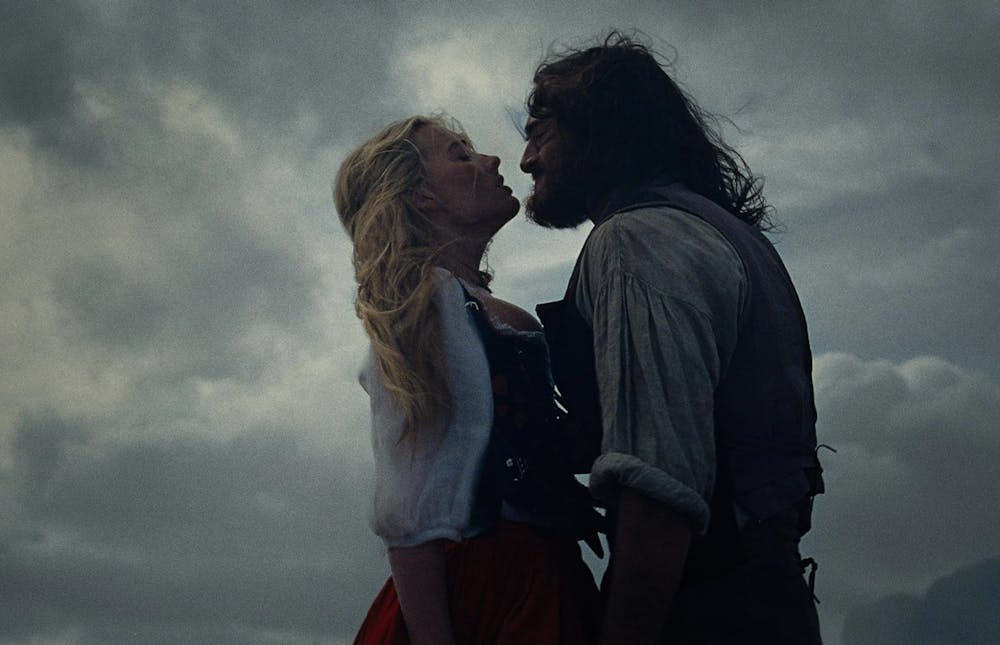
The camera frequently lingers on close-up shots of Catherine and Heathcliff — sweat, breath and skin. From Elordi’s first entrance to Catherine’s wedding, there are numerous intimate angles that initially appear sexually charged.
I suspect Fennell even intended to mislead audiences in the film’s opening moments. At first, the sounds we hear resemble someone experiencing pleasure. Instead, we soon realize they are the stifled groans of a man being hanged, a cloth bound tightly around his head.
In this way, she shocks us. We enter expecting a sexually driven period piece, yet fail — at least initially — to grasp the deeper intentionality behind the film’s intricate staging.
Moreover, the explicit imagery mirrors the nature of Catherine and Heathcliff’s relationship: messy, lustful and carnal. True to the novel, the film portrays their obsession with one another as a form of mutual control.
For example, in both the novel and film, Heathcliff marries Isabella Linton to punish Catherine and Edgar Linton. In one scene from the film, Isabella is chained up, barking and growling like a dog, animalistically obsessed with Heathcliff. This is a far more exaggerated interpretation of Isabella’s character, but in chapter 14, Heathcliff tells Nelly, “She degenerates into a mere slut!” Additionally, Heathcliff hangs Isabella’s pet dog shortly after they are wed.
Despite taking copious liberties, the story’s essence remains intact, skillfully woven into a plot even those unwilling to pick up Brontë’s dense novel can admire.
For those unaware, the film concludes halfway through the book when (spoiler) Catherine dies. However, an entire second generation follows her death in the book. In short, the consequences of Catherine Linton (previously Earnshaw) and Heathcliff’s tragic romance continue to unfold.
Well how is it “Wuthering Heights” at all? For starters, the second half of the novel is not entirely omitted but rather absorbed into the first generation’s storyline.
There is compelling evidence suggesting Fennell merges the two generations. Catherine (Earnshaw) Linton adopts several characteristics of her daughter in the book, Cathy. Likewise, Heathcliff assumes traits of Hareton Earnshaw, the second-generation character who ultimately marries Cathy.
In the film, Elordi is styled in a way that looks practically identical to Hareton. Most people did not bring up this point amidst the flood of criticism that erupted over Fennell casting Elordi as Heathcliff, who in the novel is described as a person of color.
While I do believe Heathcliff should have been portrayed by a person of color, especially given the novel’s engagement with racism, the physical similarities between Elordi and Hareton helped me to map the inner landscape of Fennel’s generational merging.
The coincidence of Heathcliff taking on Hareton’s physical appearance seems even less likely when looking at Catherine (Earnshaw) Linton. In the film, she bears a strong resemblance to Cathy of the second generation. Cathy the second is described in Chapter 18 as having “yellow curling hair,” whereas Catherine in the novel is dark-haired.
Another key point is that several scenes originally occurring between Hareton and Cathy in the novel are reimagined between Catherine and Heathcliff in the film.
Early on, we see Catherine attempting to teach Heathcliff to read, a moment that does not occur between those characters in the novel. However, a nearly identical scene unfolds between Cathy and Hareton in Chapter 32.
The same applies to Mr. Earnshaw’s birthday scene. In the film, Heathcliff defends Catherine from her father. In the novel, however, it is Hareton who defends Cathy from Heathcliff in Chapter 33. Additionally, Mr. Earnshaw in the film assumes aspects of Hindley’s role from the book.
There is an abundance of nuanced detail bridging Fennell’s film to Brontë’s novel, and the liberties it takes are beautifully executed. The soundtrack feels both relevant and immersive. I especially loved “Dark-Eyed Sailor” and the slowed-down reunion scene which, cinematically, was stunning. The intimate moments between Heathcliff and Catherine are deliberately slowed, making them all the more hypnotic.
Visually, the film paints a striking gothic landscape, particularly in its contrasts between the overcast moors and the vivid Thrushcross Grange. This contrast emphasizes Catherine’s internal world, one that feels feverish and dreamlike. She is perpetually torn between societal reality and the pull of her own heart.
Fennell also repeatedly employs red and black to symbolize the passion and aggression of Catherine and Heathcliff’s love, while also evoking unfaithfulness, sexual awakening and unrelenting grief.
On a final note, both lead performances are striking. Robbie is magnetic, fearlessly surrendering herself to Catherine’s intensity and emotional naivety. Elordi delivers a compelling performance as the brooding, obsessive antihero. I believed in Catherine and Heathcliff’s love story, partly due to Robbie and Elordi’s performances, but also because of Owen Cooper and Charlotte Mellington, who were cast as the younger Catherine and Heathcliff.
From the film’s opening, I was invited to believe in their bond. The younger actors beautifully capture the innocent yet foreboding spark between the two as children.
As a whole, I found the film brilliant. It is a bold and beautiful approach to a novel I cherish deeply. If you missed some of these details, I encourage you to revisit it. It was precisely these nuances that allowed me to find so much richness and enjoyment in the adaptation.