
By Giya Khurana
Correspondent
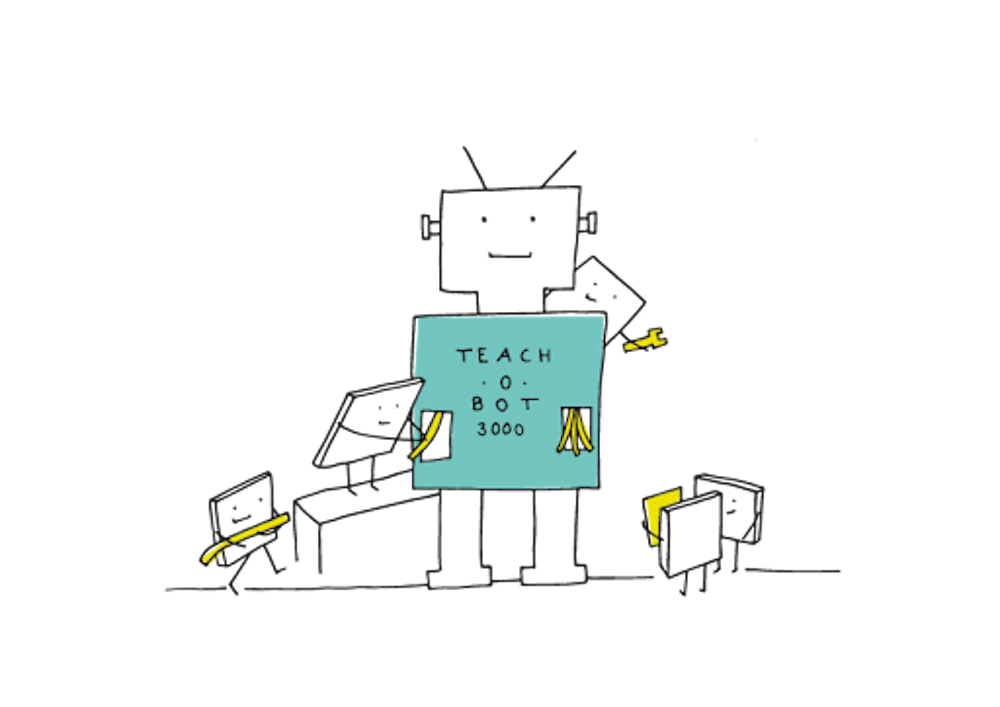
Artificial intelligence has advanced exponentially and the use of it has ingrained itself into many parts of life in just four years. From being used in and as therapy to being used by politicians, AI has grown far beyond being a chat bot.
Since its creation in the 1960s, AI had been developing over time until 2022 when it went mainstream with ChatGPT, Georgia Turner wrote for the Royal Institution. The start of AI was to bring further analysis to questions, being adapted similarly over time. However it is now being used and seen on and off the internet.
“Over a quarter of U.S. workers — and 45% of those with postgraduate degrees — report using ChatGPT for work,” according to OpenAi's website.
A concern now being faced is how AI will affect jobs and the livelihood of workers moving forward with its rapid growth.
In late 2024, a billboard started popping up in San Francisco with the headline “Stop Hiring Humans,” commissioned by the company Artisan. Variants of the billboard started gaining attention online in 2025.
“The goal of the campaign was always to rage bait, but we never expected the level of backlash we ended up seeing,” said Jaspar Carmichael-Jack, CEO of Artisan, in a statement on the Artisan website, sharing the reason for the billboards.
Erick Cruz, a COO at Carmo Companies, a private equity and conference organizing firm, said this situation is a mix of being “short sighted, selfish, and greedy.”
“It’s kind of short sighted, how do you get customers,” said M. Desai, an engagement manager for a pharmaceutical company. “Are you selling to another AI? If I’m a business owner and all my employees are AI, and I have to sell to another business and all of their employees are AI, why don’t the CEOs just talk?
“Also it’s just downstream bad economics,” Desai added. “If goods and services [are] just done between AI, it’s unrealistic. You’re talking about completely removing a lot of purpose for people, people who love doing their jobs, [some] people’s identities are connected to the jobs they do. At what point do you say I’m going to replace the CEO with an AI.”
“AI in its current state, if it continues on the current track, it will create more jobs than it will take,” said Carmichael-Jack on a panel at TechCrunch Disrupt October 2025, Kron4 reported, a local news organization from San Francisco.
In recent news, a different trend from that of Carmichael-Jack’s statement is taking shape.
Last month, “Pinterest and Dow announced layoffs, [crediting] the job cuts in part to a shift to artificial intelligence,” CBS reported on Feb. 27.
Cruz said, “AI should be used to enhance the current workforce, make it more efficient and or train [employees] better.”
“Our CEO made it clear, as we were hiring recently, that the job won’t be replaced by AI,” Cruz added.
Cruz said he had not heard of other companies integrating AI over human employees, nor did Delmis Vargas, a senior finance major at the College, who said, “I've seen it integrated but not fully replacing people yet.”
However, noting developments similar to the CBS report, Desai said he “100% has seen it.” Desai noted that Amazon had been “laying off in waves.”
On March 11, The Guardian reported that almost 10% of roughly 350,000 corporate employees at Amazon have been laid off in the past four months, and pressures had risen on the remaining employees to integrate AI.
Desai mentioned the company Square, now Block, and their layoffs, as well as a tweet by their CEO, Jack Dorsey, for the reason for the layoff.
“We're reducing our organization by nearly half, from over 10,000 people to just under 6,000. That means over 4,000 of you,” Dorsey said in his tweet on Feb. 26.
“[Artificial] intelligence tools we’re creating and using, paired with smaller teams, enabling a new way of working [changing] what it means to build and run a company… we're going to build this company with [artificial] intelligence at the core of everything we do,” Dorsey added.
Dorsey claimed he had two options, one to layoff employees in waves or “be honest about where [they] are and act on it now.”
These are just a few companies that have shared the reason for their start or continuation of job cuts this year. However, there has been a slow growth to the cuts seen since 2022.
“Employment for 22 to 25-year-olds fell 6% between late 2022 and July 2025,” ADP Research reported in August 2025.
Vargas had explained her distaste for AI integration in all spaces. “There should be limitations, we shouldn't use AI for simple tasks,” Vargas said. “It’s bad for the environment, it's just not good for us humans to rely on it.”
Adding in she is slightly worried for the job market but, “I think there will be usage for humans,” said Vargas. “AI still makes so many errors and small mistakes, it can cost more money with those errors than human error.”
The mistakes have already started to creep up. From the March 11 report, The Guardian highlighted how Diane, an Amazon employee who joined in 2024 to write code for the company, is now “mostly fixing what artificial intelligence breaks.”
There is no telling what the future will hold with AI taking over while it also needing human help to adapt and be fixed. Cruz and Desai both think some jobs will be lost but there will be an adaptation from the public and a shift in the economy.
Desai said 70% of his job will be lost in the future, but mainly for certain manual tasks like spreadsheets, emails, working with system records and obtaining contact information. “They won't be necessary,” for him to do, Desai added.
However, Desai concluded that AI can’t replace people. “Weirdly, it might just bring us away from our phones,” Desai said. “Sending a message to [a chat bot], it does all the work for me, now I don’t have a reason to look at my phone anymore.”