By Jack Salaki
Correspondent
Human beings have been on this planet for a very long time. Modern humans, as we are today, emerged roughly 300,000 years ago. During this time, we have both built and destroyed. Empires have risen to great power and turned into dust, and within all of this time, there have been periods of great flourishing and misery.
Over that long stretch of time, something has become clear: humanity’s dual nature. Human beings are capable of creating incredible wonders, things that in the past would seem like mere fantasy.
Take the progress made over the last century as an example of that. The Civil Rights movement drastically changed old ways of discrimination. The Internet democratized information and allowed anyone with the willingness to learn new information to do so.
These two things alone show us both the social and technological progress that has been made. Human ingenuity and thinking have pushed society forward, making the world today unrecognizable from where it was in 1926.
Yet even with this progress, there is also a darker side of humanity. Despite, in some ways, being in a more civilized age, divisions from the past continue to re-emerge in new ways. Hatred, war and violence were not things that could be erased entirely, but it seems they are part of the human condition. It feels as though the present moment in history is more defined by backsliding than progress.
That is why Artemis II stands out to me.
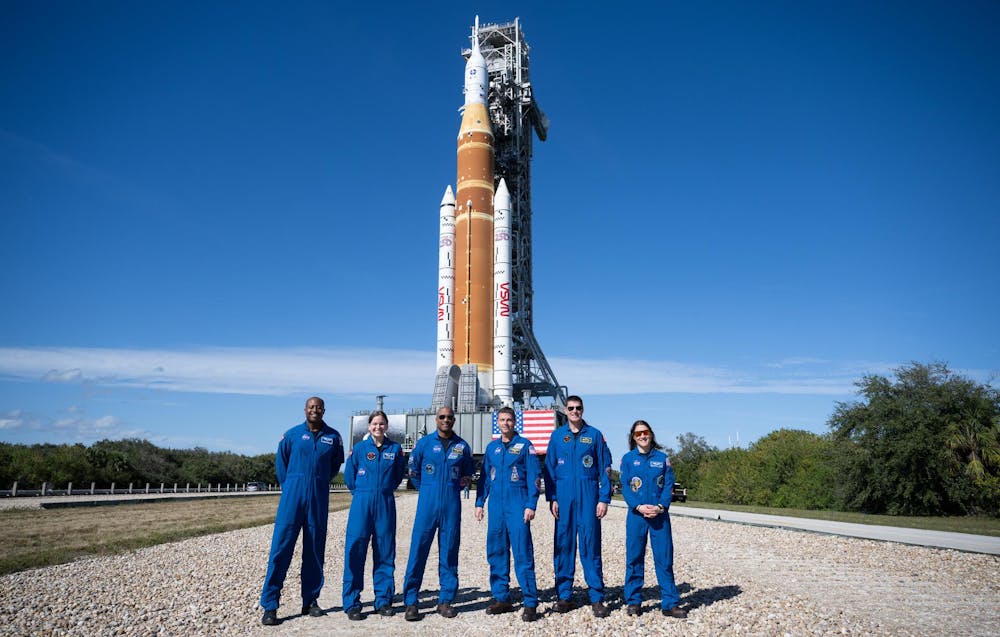
Artemis II is a 10-day crewed mission led by NASA, set to launch on April 1. The mission is sending four astronauts on a trip around the moon, which marks the first time we've left low orbit since 1972.
This mission is designed to test NASA's Orion spacecraft, which is going to eventually carry humans to Mars and into deep space.
To me, the launch isn't the most important thing. Neither is the testing of a new kind of technology. What matters most is what the mission represents.
On Sept. 12, 1962, President John F. Kennedy delivered a famous speech at Rice University. In his speech, he promised that the United States would land a man on the moon by the end of the decade.
Kennedy remarked, “We choose to go to the moon in this decade and do the other things, not because they are easy, but because they are hard.”
His words remain powerful today. They capture the belief that humanity is capable of coming together and accomplishing seemingly impossible things. Furthermore, they showed what America was capable of.
It wasn’t just a technological triumph for the U.S. to land on the moon before anyone else, but an ideological one. Of course, our greatest ideological rival: The Soviet Union was attempting to do the same thing. In defeating the Soviet Union, we also achieved a symbolic victory in the Cold War.
Fast forward to today, and the Artemis II mission possesses the same underlying spirit: one that continues to be strong despite times that try to erase it.
In an era when it can feel as though human progress has slowed or that our worst impulses, those of war, division and greed, take the reins, Artemis II reminds us that we are still capable of greatness. It shows us what can happen when we focus on what we can build rather than what we can destroy.
This mission may be small, but it heralds a new era: one in which humanity will eventually move beyond Earth to the moon, Mars and beyond. It is the beginning of the second space age.
With everything happening in the world today, perhaps what we really need in order to begin to make progress again is to look up at the stars.