By Sarah Neil
Correspondent
The College recently received a grant of $250,000 from the New Jersey Department of Environmental Protection and Sustainable Jersey as part of Trees for Schools, a tree-planting initiative to plant hundreds of trees on campus.
Many other schools, including Hamilton Township School District and Paul Robeson Charter School, also received funding from this grant.
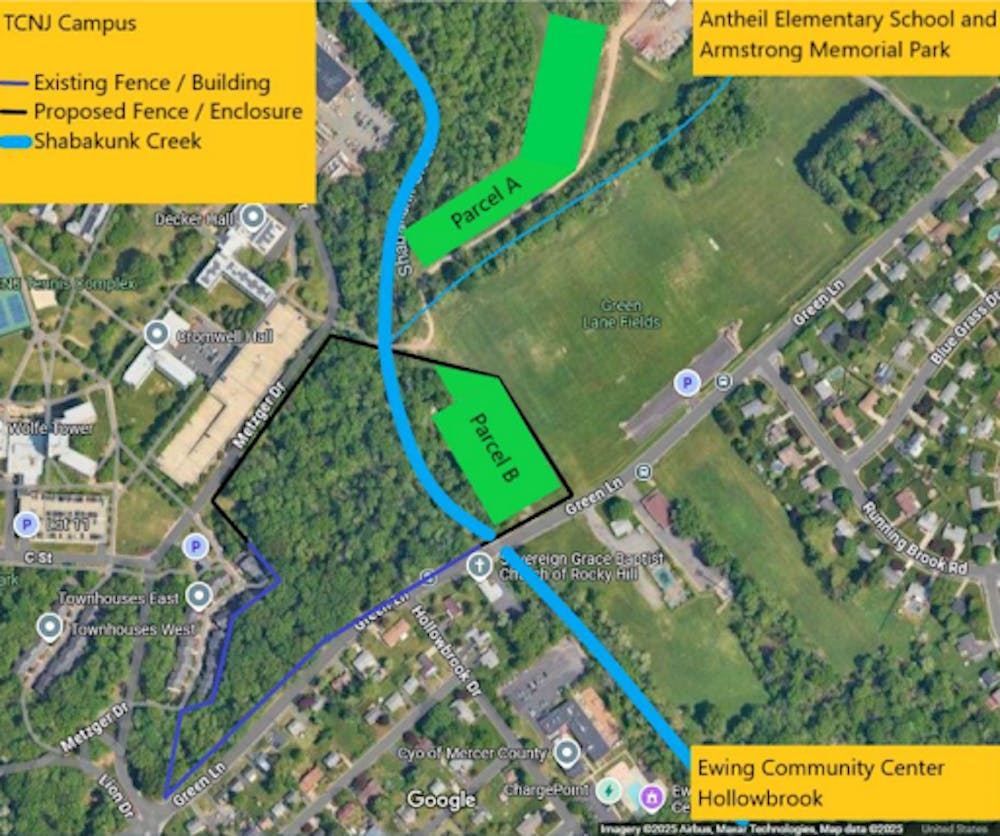
The College’s new trees, which will be a mix of various native species, will be planted in autumn near the Shabakunk Creek on the College’s property. The planting locations are on the exterior of campus, extending the already existing forested areas there.
Trees for Schools encourages the planting of native trees, which helps to maintain the natural biodiversity of the environment and best supports the other native species nearby. Included in the College’s list of trees to be used in the project are white oaks, river birches and tulip poplars.
The planting is expected to bring many benefits to the Ewing community. While the trees will be on the campus itself, neighboring properties such as Anthiel Elementary School and Hollowbrook Community Center will also reap the benefits.
“[This project] serves to address stormwater runoff and mitigate flooding in the area, it also serves to clean the water,” said Paul Romano, senior director of sustainability and energy management at the College.
Not only that, but the trees will also help to clean the air by taking in carbon dioxide from the atmosphere.
“This is about all of the benefits of trees, but we do have an emphasis on carbon sequestration,” said Melanie McDermott, senior researcher at Sustainable Jersey. The carbon captured by these trees will be tracked over their lifetimes as part of this project.
The funding for Trees for Schools comes from the Regional Greenhouse Gas Initiative, which is a program that aims to cut down on emissions of greenhouse gases. Tree planting is one way to help minimize the effects of carbon emissions.
The grant also covers the costs of fencing and deer guards for the planting zones to prevent deer from eating the young trees.
“A lot of our forested areas have been devastated by deer overpopulation,” said Romano.
Deer guards and fences will be used to protect the saplings as they grow, greatly increasing their chance of survival. It also provides an opportunity for native shrubs and grasses to repopulate the area. Through this, the plots will start to more closely resemble the natural forests that once occupied the space.
The success of these plants also relies on the efforts of students and community members. Romano and McDermott are both hopeful that volunteers will come together to support this project, whether that be by helping to prepare the site or by studying the effects of the planting on the ecosystem.
“There’s a big role in monitoring the trees, tracking them as they grow over time. There’s a lot of interesting studies that could be done,” said McDermott.
While this project will allow the DEP and Sustainable Jersey to work on improving their environmental restoration practices, it will also provide major learning opportunities for the community.
There are efforts being made now to involve more people in the process, allowing for community members to learn more about environmental restoration and conservation and how initiatives like these can benefit neighborhoods.
“I think the most exciting part of this project is building awareness and sharing, with concrete examples, these lessons with the immediate community,” said Romano.