By Bryce Maher
Correspondent
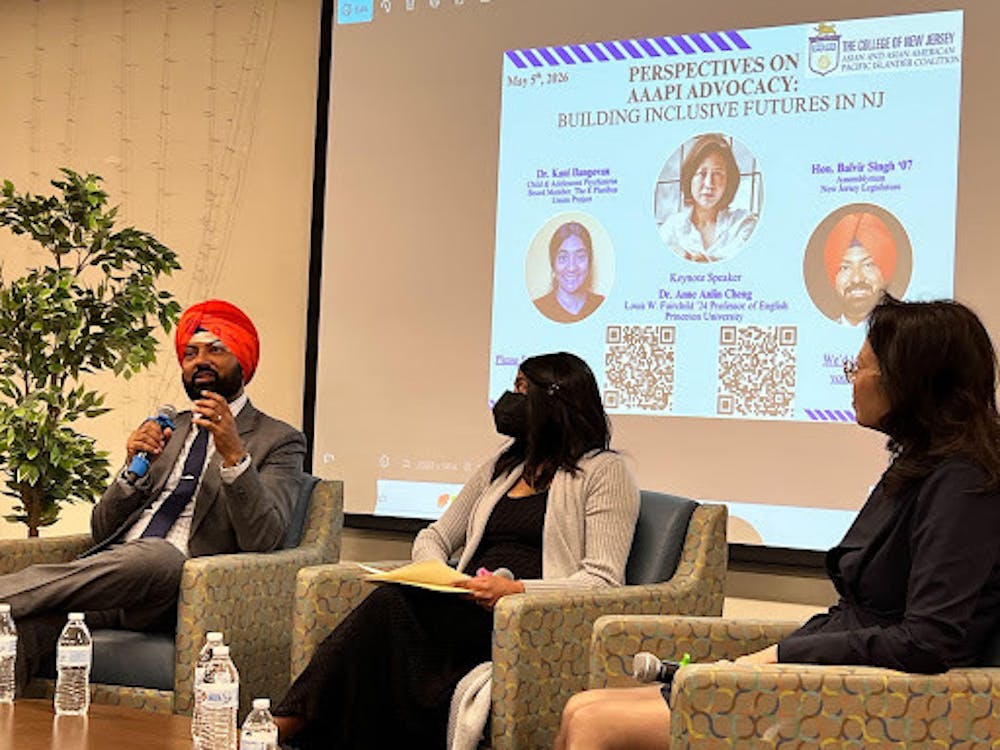
The College’s Asian and Asian American Pacific Islander Coalition hosted the event “Perspectives on AAAPI Advocacy: Building Inclusive Futures in New Jersey” in Roscoe West Hall’s Intercultural Center on May 5. It featured three panelists from the AAPI community: Princeton University English professor Anne Anlin Cheng, Child and Adolescent Psychiatrist and Board Member of The E Pluribus Unum Project Kani Ilangovan, and New Jersey Assemblyman Balvir Singh ‘07.
The AAAPI Coalition consists of employees from the College who self-identify as Asian or Pacific Islander, as well as those whose research or personal interests relate to AAAPI culture and history.
Before the event started, the audience of over 70 people, including students, faculty, staff, administrators and alumni, had a chance to grab the provided lunch: a variety of Asian cuisine. The event officially began with an opening remark by Yifeng Hu, a communication studies professor and one of the coalition’s co-chairs.
Cheng shared her experiences related to anti-Asian hate from her book “Ordinary Disasters: How I Stopped Being a Model Minority.” She discussed Asian pessimism and how members of the AAAPI community were treated during the peak of COVID-19.
Cheng underwent chemotherapy during the pandemic, when the whole world became “sick” with racism — a racism that was downplayed because it targeted members of the Asian community. She asked the question: “Are Asian Americans ‘injured’ enough to be categorized as racism?”
This question connects to the myth of Asian Americans being the “model minority,” meaning they’re inherently successful because of their race, which made people think it was okay to discriminate against them, giving them many “invisible cuts.”
This feeling of being politically “invisible” resulted in Cheng feeling a mixture of “relief and sorrow” as anti-Asian hate crimes became more prevalent during the pandemic, because even though the events were horrific, people would at least finally become aware of what was happening to members of the Asian community.
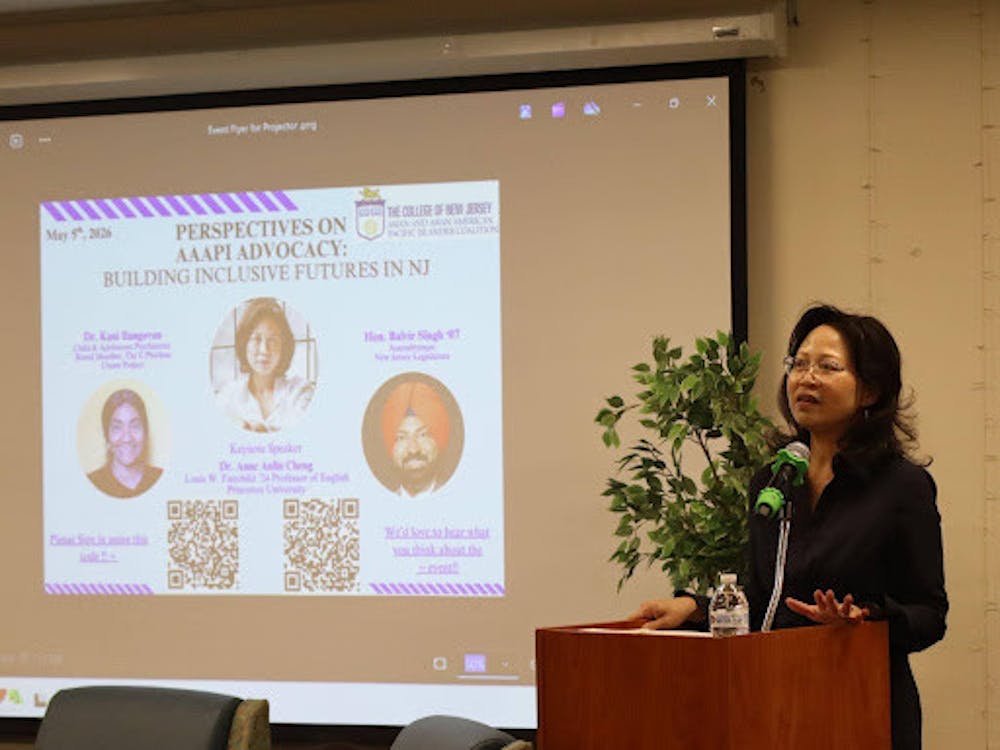
Anne Anlin Cheng delivering her keynote speech. (Photo courtesy of Bryanna Carrie)
During the panel, which was moderated by Coalition Co-chair and Training Coordinator of Counseling and Prevention Services Jonathan Murakami, the panelists discussed what inspired them to become advocates. Ilangovan told a story about her childhood, saying she would color her skin with a peach crayon instead of a brown one because she wanted to fit in with the other kids with white skin.
Now, as an adult, when she went to her daughter’s school, she saw kids doing the same thing. This made her realize that despite all of the strides that have been made in terms of AAPI representation over the last few decades, it’s still not enough, and more needs to be done in the school system.
Jordana Levine ‘21, also of Asian heritage, was moved by the story, saying it “brought back memories of similar moments from [her] own childhood, where subtle messages shaped how [she] viewed identity and belonging.”
Nyah Jeter ‘27, a junior communication studies major, said she’s seen similar stories “countless times in [her] own community,” and that “growing up, whiteness was shown to be the default and it showed in the little ways, such as an abundance of peach crayons versus a severe lack of tan or brown crayons.”
Ilangovan decided to take matters into her own hands, spearheading a movement to have classes about Asian American history be available for grades K-12 in New Jersey. This movement resulted in the passage of the New Jersey Asian American Curriculum bill in January 2022. Thanks to her efforts, her daughter’s school now has two Asian American studies classes, one of which she states was the best educational experience her daughter has ever had.
School of Education Professor Arti Joshi said Ilangovan’s story demonstrated “the power of what one story and one voice, when combined with others, can do to bring about meaningful change.”
On a similar note, Cheng showed her students famous AAPI court cases in American history. One student of AAPI heritage came up to her and said, “Thank you for teaching this class, because I never realized I own a piece of American history.” Cheng found this incredibly moving, but also saddening at the same time, because she felt as though the AAAPI community shouldn’t be just finding out the legacy of their cultural group once they get into college; they should know about it far earlier.
Singh discussed his road to advocacy, saying it consisted of a bunch of “small jolts” that eventually culminated when his livelihood was at stake due to new legislation in New Jersey in the early 2010s. This made him decide to run for the school board, which eventually led him to decide to be an assemblyman and put his voice out into the world.
The College’s Director of Online Learning Ellen Farr had nothing but praise for Singh, saying, “[He] represents my town. He’s always had my support. It was great to hear his perspective on this important topic.”
The audience was energetic throughout the panel. Farr called the event “terrific,” saying, “In this day and age, in particular, we need a shared, safe space to explore complex social and cultural issues.”
“I loved how vulnerable each speaker was,” Jeter said, emphasizing the importance of having a safe space “to learn about the experiences of marginalized communities without fear of judgment,” and that she hopes “to read one of Cheng’s books soon.”
Joshi was inspired by the event, saying she’s “more motivated after this conference to become actively involved in advocacy, specifically in the areas of curriculum design and implementation.”
May is AAPI heritage month, but as Singh mentioned during the event, AAPI history “is not some document that gets pulled out for a specific month” and then put away, “it’s part of American history.”