By Sandra Abrantes & Natalia Tomczak
Multimedia Coordinator & Opinions Editor
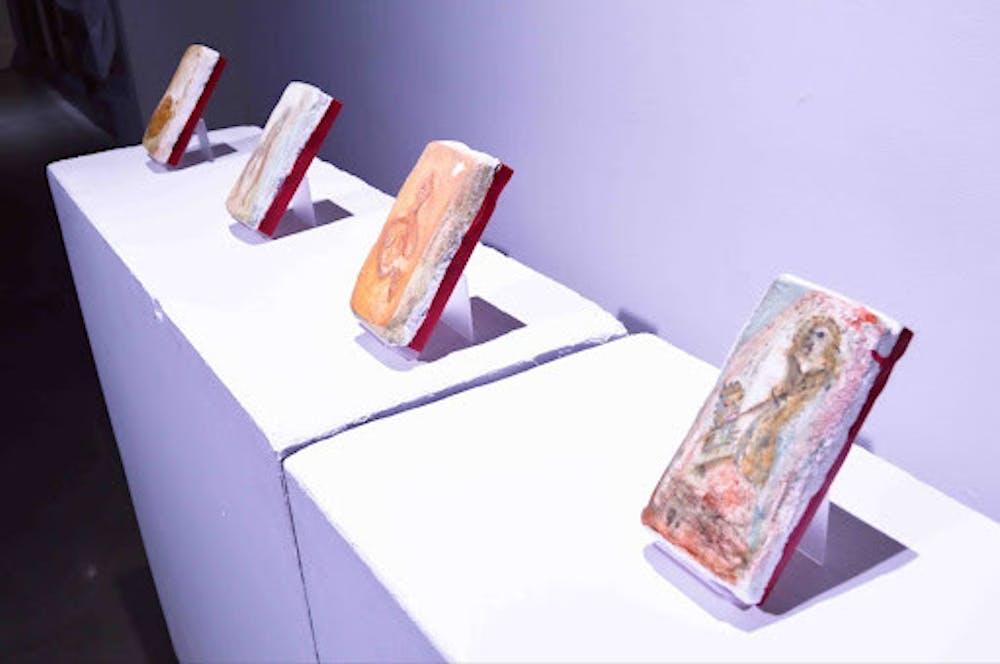
The exhibition “What Images,” curated by Lindsey Arturo and Kaitlyn Paston, explores artists’ personal responses to their own crisis with images or their image-making process. It is on display from March 12 to April 5 in the College’s art gallery in AIMM 115.
Inspiration for the exhibit comes from the various ways in which technology has shaped how we see images.
“We’ve been having a lot of conversations with people about how images don’t mean the same thing or are not experienced in the same way that they used to be,” Curator Paston said. “This has been happening for ages, but what’s changed in recent years? With this constant stream of images on our phones and video everywhere at all times, we have this crisis of image.”
“We’re definitely responding to the fact that we’re making images in a world where there’s AI everywhere,” Paston added.
The pieces in this exhibition, curated from ten different artists, explore themes of commercial images, the value preserved in the Hollywood image, the development of a climate controlled viewing experience for cinematic images, the history of painted images within contemporary modes of viewing, narrative human bodies presenting reality, dispersion of control, disassociation from the natural world and image obsession and fatigue.
The exhibition contains art from artists located all around the world: China, the United Arab Emirates, the United States, Brazil and Iran. They met through grad school or residencies and formed these international art friendships.
An unintentionally impactful part of the exhibition is that the artist from Iran was unable to display their work. Due to the current war, the artist was unable to communicate with the curators and unable to send their piece. Instead of this, a paper was displayed labeling the artist, Arghavan Heydareslam, and why she was unable to send her video.
Paston explains, “We were literally in contact with her until the bombing started, and then she lost power.”
The opening night began with an audiovisual performance at 7:30 p.m. Paston worked with a table and paper cutouts, playing with light and shapes, as pre-recorded images of nature provided the background to her movements.
A consistent visual throughout the performance were paper cutouts in the shape of a person in motion, used on top of the pre-recorded videos. This visual comes from Paston’s artistic background, as she had been working in animation, but decided to take a break from it when she found inspiration playing with these mediums in a live format.
They used a program called Max MXP to facilitate this live video process. There is sound input coming in while it switches between the clips, triggering each one to play. “The sort of video acts as a score for all of us so that we're all playing at the same time, and making at the same time,” said Paston.
While these images were being projected, musicians improvised on the bass guitar and clarinet, along with a bunch of pedals, to create a unique ambient sound that changed each time it was played. The sound was inspired by the fragility of Earth’s surface. Specifically, Paston took inspiration from nature in Southwest Virginia, where erosion and mining caused holes in mountains and beneath rivers.
This makes the outcome incredibly unique. “It’s definitely improvised,” Patson describes. “We knew the arc, but otherwise it sounds totally different every time. So then it looks different every time because I’m responding to them. It’s more like, how do we listen to each other?”
This aspect of the performance reiterates this notion of playing with creativity, as each individual responded to the visual and auditory aspects of the performance differently, and worked off of the others’ sound and visuals to create something together.
The vocals that accompanied the show were performed live, as Paston sang a piece about somebody waiting for a one-armed robot they’re in love with. She sees this robot as a metaphor for all of us being on our phones all the time.
“What Images” encourages us to play with the creative process. It curates personal responses from artists about what it means to create images, and examines who sees and interprets them. Ultimately, “What Images” questions what it means to create and consume meaningfully while living in a digitally saturated world.