By Sky Pinkett
Features Editor
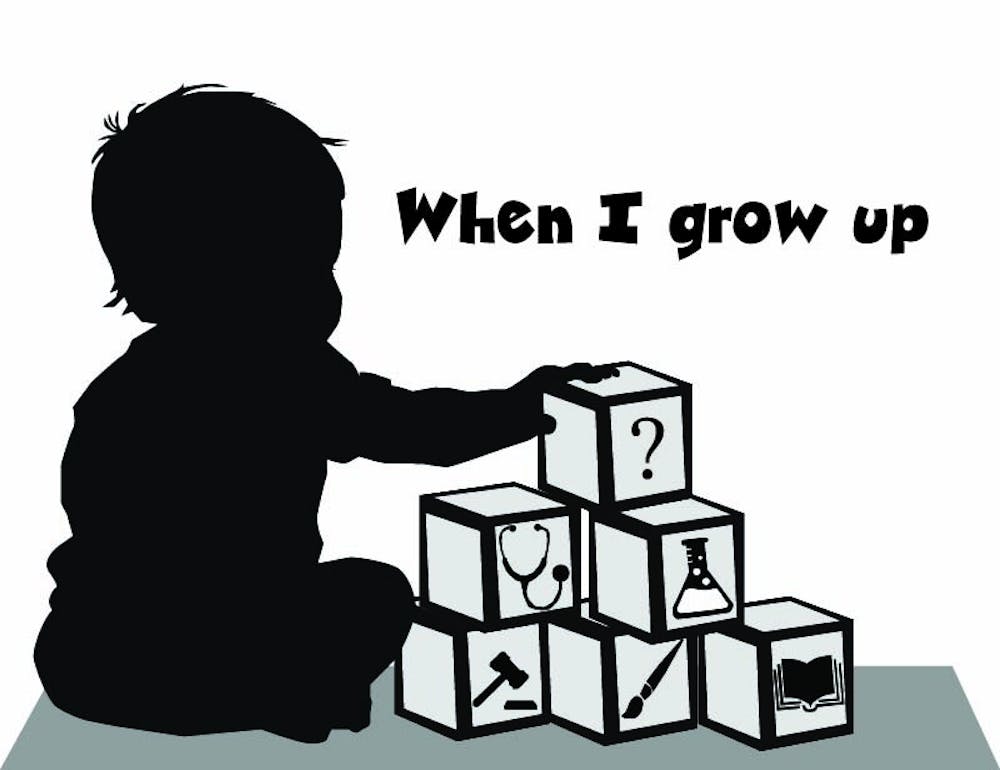
Around 80% of college students change their major at least once, with the average professional changing careers at least five to seven times in their working life. When I Grow Up is an academic spotlight series that digs deep into the majors offered at the College. It details opportunities, future job prospects, testimonials from students and professors, and how a major may be a good fit for you.
The very first spotlight for this series is the journalism major, which arguably, is the discipline that has made articles such as this one possible.
From informing the masses of important local, national and world events through establishments such as The New York Times and Good Morning America, to exposing powerful people from former President Richard Nixon during the 1970s Watergate scandal, the mid 2010s #MeToo movement and even the modern day Epstein files discovery, to Diane Sawyer's infamous celebrity interviews and current social media news sites like Vox — all of this is journalism.
Merriam-Webster dictionary defines journalism as, “the collection and editing of news for presentation through the media.” This definition casts a wide net, and includes article writers, news anchors, the production crew for news companies such as CNN and Fox News, and even photographers and social media curators.
At the College, the journalism program resides in the School of the Arts and Communication. In addition to a journalism and professional writing major or minor, students also have the opportunity to pursue a broadcast and multimedia journalism minor, social media minor and other related communication minors and majors.
According to Abhinav Aima, one of the College’s newest journalism professors, the College’s journalism program stands out as ideal for students wanting to explore journalism in all its interdisciplinary glory.
“TCNJ’s journalism program has a rich history of highly-engaged and award-winning student journalism,” Aima said. “Along with retaining valuable and functional core competency programs that support journalism — training in film, TV, radio and multimedia platforms, along with opportunities for students to explore art, music, business, technology and social sciences, in order to broaden their core interests in journalism.”
Students have found benefit in the College’s cross-disciplinary approach to journalism, as senior journalism major Rebecca Wechter has experienced, who also has a minor in pre-law and psychology.
“I took Journalism 101 and then news editing and production, stuff like that.” Wechter said. “And then there's a lot of really cool electives. I'm actually taking one this semester called ‘Globalization and International News’ that is one of my favorite classes that I've taken for journalism here because I feel like I'm learning a lot about history. I feel like I'm able to actually learn a lot of stuff.”
The journalism major has undergone much change to resemble what it is today. When Kim Pearson, one of the College’s journalism professors until 2025, started working at the College in 1988, journalism was a small program absorbed within the English department.
“At that time, journalism was led by Dr. Robert Cole, whom you will find celebrated in the digital archives as Father Journalism,” Pearson said. “Bob joined Trenton State College in the early 1970s after a respected career in newspapers and earning a PhD in English at Lehigh University. In the early 1970s, journalism courses were popular because of the impact that news coverage of the many major events of the 1960s had on daily life and political culture.”
The journalism program has come a long way since then and continues to evolve, as Aima’s and fellow journalism professor Kathleen Webber’s future plans for the major indicate.
“I’m working with Professor Kathleen Webber to streamline our course offerings to focus on providing students with a progression-based curriculum,” Aima said. “I also hope to contribute to the curriculum based on my academic and professional background… through coursework that promotes the understanding and implementation of journalism’s core foundational role as a form of engagement with our democracy, with a focus on social responsibility.”
On the College’s journalism and professional writing website, the major is described as “interdisciplinary, so it offers a broad range of courses in writing and other areas of study.” For Aima, who was applying to teaching jobs in other state colleges besides New Jersey, even as far as Dubai, this was what appealed to him about the College’s journalism program the most.
“I was highly motivated to join TCNJ because the campus has the legacy infrastructure of an award-winning historic student newspaper, The Signal, which has successfully sustained efforts to grow as a digital journalism entity,” Aima said. “I was impressed by the campus infrastructure that included award-winning faculty and staff providing a functioning TV studio for training students in broadcast production, a student-run radio station, as well as students involved in film production, magazine journalism and interactive multimedia.”
In addition to The Signal, students have the opportunity to explore their journalistic interests and build their resume in other student organizations such as Her Campus, Lions Television, WTSR 91.3FM student-run radio and other student clubs.
“In this environment, students can learn to integrate these multidisciplinary skills in order to continue to build on a digital journalism program with creative and innovative thinking across a wide variety of diverse student’s capabilities and passions,” Aima said.
The many opportunities the College offers for journalism majors is something that will strengthen their future career prospects. According to the U.S. Bureau of Labor Statistics, “Employers generally prefer to hire candidates who have had an internship or have worked on school newspapers, radio stations or TV stations.”
“I feel like [the College] does a decent job in terms of sending out, you know, internship opportunities and like different job opportunities,” Wechter said. “The internships I've gotten have actually been mostly through my advisors sending out emails being like, ‘oh, you guys should apply for this.’ With those, I was able to actually get them. So I feel like that's very helpful.”
In terms of salary, journalists are reported as making an average of $60,280 per year, with the projected job outlook being on a slight -4% decline from now until 2034.
“Journalism requires a high level of passion. Students need to be excited about their work, and feel self motivated and driven to do their best work,” Aima said. “It is an industry that, throughout its history, has struggled to offer high paying entry-level work, and usually sees a fair amount of early career attrition - with young journalists feeling burned out and seeking other types of employment in the related media industry that may be more lucrative, or offer better work hours.”
Despite these statistics, professors and students alike see an even stronger reason to step into the journalism field.
“I like to get to know people's stories, you know,” Wechter said. “I guess that's kind of like the cliché answer, but it's true. I like asking questions, just trying to learn more about people.”
“It is deeply rewarding work that has been at the center of American democracy for more than 250 years,” Aima said. “I have been in academia for over 25 years now, and the most enriching part of my career has been the opportunities I’ve had to engage with students in reporting and producing news stories.”
With passionate staff members and a robust program that continues to adapt to current communication trends, the College is a strong contender for those looking to study journalism. While the program itself continues to change and improve, the reasons for its existence remain the same as they were back in the politically turbulent times of the 1960s.
“American journalism was always globally curious and locally relevant, even before the days of the telegraph,” Aima said. “It is a great tradition of paying due consideration to the human condition that we can not take for granted in our seemingly instantly connected, but often misinformed, world.”
For more information about the College’s journalism program, as well as steps to take if you are interested in pursuing a journalism major or related minors, check out the College’s website.