![<p><em>Current EPA Superfund sites compared to historic Trenton pottery sites. (Photos courtesy of EPA [upper], Potteries of Trenton Society [lower])</em></p><p></p>](https://snworksceo.imgix.net/njs/62e6e338-192d-4205-a88c-65f2bfb539c1.sized-1000x1000.png?w=1000)
By Alyssa Serrano & Sarah Neil|
Correspondents
Trenton makes, the world takes. And now, centuries later, communities ache. Decades of pollution from factories in East Trenton have created dangerous conditions for hundreds of residents, and the problem is only now starting to be addressed.
For over 150 years, the lead used to glaze Trenton’s famous ceramics has been seeping into the local landscape. Today, that legacy has landed East Trenton on the EPA’s National Priorities List, triggering a federal investigation into soil contamination that spans generations. However, residents have been left wondering what comes next.
Trenton’s legacy as an industrial powerhouse, or in this case, an industrial pollutant, goes all the way back to the 1850s, when Trenton established its first pottery factory. Soon after the first was established, other factories began popping up in the area, and by the 1900s there were almost 50 ceramic factories in the area. At their start, these factories largely focused on an “All-American” style of tableware. But soon after, some began creating porcelain artwares and focusing on luxury aesthetics and designs.
Trenton’s proximity to both railroads, and the Delaware and Raritan Canals, made both getting supplies and transporting items extremely easy, and allowed for rapid growth and production, so it was an ideal location for these factories.
The glazes and coatings used on the pottery contained lead, so when the pottery was baked in the factories’ kilns, lead would be released into the air, and ultimately settle as a film over the ground and area. Beyond these emissions, imperfect pottery that did not meet quality standards would be thrown out on-site without proper disposal, with the shards leaving a buildup of lead products in the ground that polluted the soil.
According to the World Health Organization, there is no “safe” level of lead, as research has shown that even small levels can be dangerous. Lead is absorbed by the body and will remain in things such as organs and bones, and should something happen, it can be released into the bloodstream and become immediately life-threatening. However, the largest cause for concern is the damage it does to the brain and nervous system over time, which can result in seizures, brain conditions or death.
The main locations of concern are scattered throughout East Trenton; however, even the farthest location is only around 20 minutes away from the College.
Many of the areas left polluted by these factories are now populated by homes, parks and a public school, which is especially concerning because children are significantly more vulnerable to lead poisoning. According to the World Health Organization, “Young children are particularly vulnerable to lead poisoning as they may absorb up to 4–5 times as much lead as adults from an ingested dose.”
Once the areas of contamination are identified, the EPA sends out crews to test the lead levels on every affected property. They collect samples from all throughout the area and at many soil depths, using a sieve to filter out and measure the smaller particles of lead.
“Lead exposure for children is going to be from those very fine particles,” said Joel Petty, Remedial Project Manager for EPA in an interview.
This is the stage EPA is in now, and it will take several years for testing to be completed. Sampling started at this superfund site in 2023, following a few years of investigation. The site spans almost 20 blocks in East Trenton from Plum Street to Monmouth Street. It includes three parks, as well as Grant Elementary School. Once testing is done, it will take several more years to develop a remediation and/or removal plan for each area, and more years to carry out that plan.
Currently, the most difficult part of the process is gaining access to all of the properties in order to conduct soil tests. Many of the affected residents are renters, meaning the EPA has to seek out the owners of the land, who, even once they are contacted, may not be willing to work with the agency.
“It's a lot of work and effort on our end to try to work with each of these property owners,” said Petty.
In the meantime, residents are still at risk of exposure to lead, so EPA provides a few safety measures for those at higher risk, like pregnant people and children.
On those properties, alternative soil covers are provided by the EPA.
“That’s mulch, stone or a thin layer of topsoil with grass seed planted on top,” Petty said.
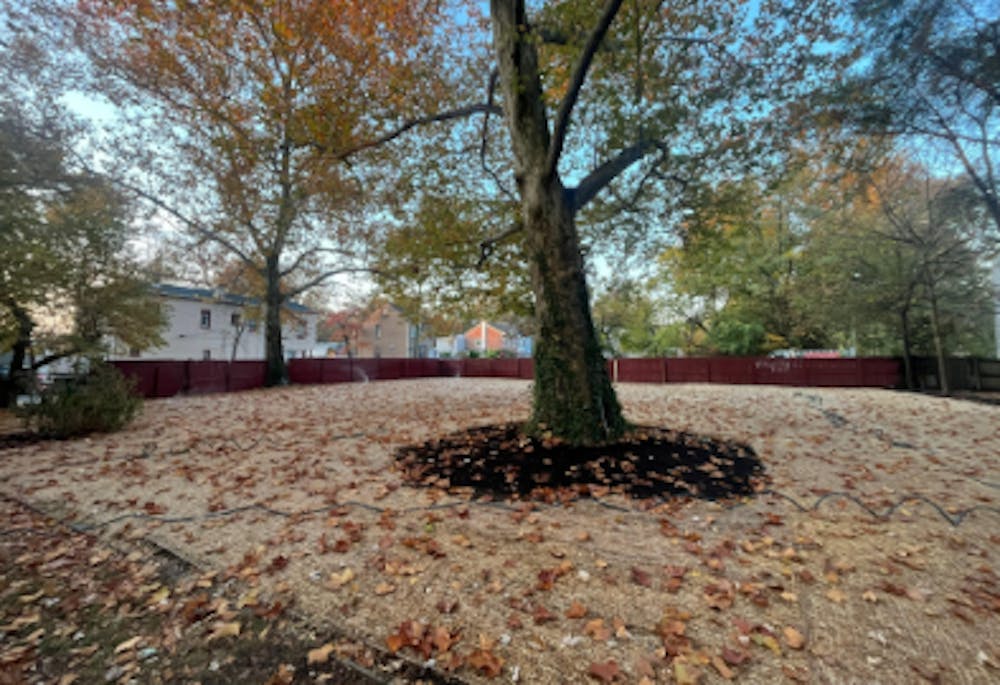
Alternative soil cover. (Photo courtesy of Joel Petty)
This helps to prevent direct contact with lead-contaminated soil, although it is only a short-term solution. Alternative ground cover can be used in both private residences and public spaces like parks and schools.
“If there's active gardening occurring, they would be eligible for raised garden beds so we can make sure people aren't planting in the contaminated soil,” said Petty.
For properties that are ineligible for either of these solutions, EPA focuses on education. This includes door-to-door outreach and providing residents with flyers and infographics that outline the ways that people can stay healthy around lead.
The EPA recommends preventative steps to reduce lead exposure, such as taking off shoes before coming inside and washing hands after touching the ground.
“There really are a number of different, pretty simple steps. But when you put them all together, it makes an impact,” said Petty.
There are barriers to education, however, as a large percentage of the population in East Trenton are native Spanish and Haitian Creole speakers. The EPA does staff Spanish speakers, but they often have to outsource interpreters for Haitian Creole.
In order to improve their impact on the community, the EPA also works with local nonprofits like East Trenton Collaborative, which aids in conducting community outreach.
“It's an ongoing process, so as we expand, we'll hope to identify those kinds of groups in other parts of the community and continue building our community outreach work,” said Joel Waddell, Community Involvement Coordinator for EPA.
For those who want soil testing or more information on how to stay safe, it is recommended that they reach out to EPA representatives. A list of contact information, as well as documents about the site and safety measures, can be found on the EPA’s website.