By Emily Lindsey
Correspondent
Artificial intelligence developers are adamant that a doomsday situation could be imminent if Congress does not slow the advancement of AI with legislation in their final week in session this year, according to The New York Times.
Ex-Anthropic AI developer Jacob Coxon recently took to X and posted the following statement after his resignation: “The people building AI earnestly believe that it could kill us all by the end of the decade,” NBC News reported.
On Sept. 12, Anthropic CEO Dario Amodei followed Coxon’s post with a 3,800 word essay on why it is imperative that the growth of AI is slowed, as reported by The Associated Press. Amodei explained that the newfound sense of danger surrounding AI is related to its ability to “build the next generation of AI” all on its own.
However, this desperation for action is not just limited to one developer; the biggest stakeholders in the industry are all chiming in.
The same day that Amodei published his essay, Elon Musk, owner of xAI and Spacex, posted a brief affirmation on X that “Dario is right.”
According to The Hill, “Sam Altman, CEO of OpenAI, also took to social media in support of Amodei’s plea.”
NBC News reported that Republican Senator Josh Hawley’s ongoing investigation of OpenAI as the chairman of a Homeland Security subcommittee on disasters informed Congress on the gravity of the situation. Senator Hawley is looking at how OpenAI’s AI agents pushed past the bounds of their coding and independently chose to hack another AI program called Hugging Face.
Still, Congress members’ responses to this incident have varied widely. Democratic House Minority Leader Hakeem Jeffries has demanded immediate congressional action and led a call for the planned congressional recess to be delayed until legislation on AI is passed.
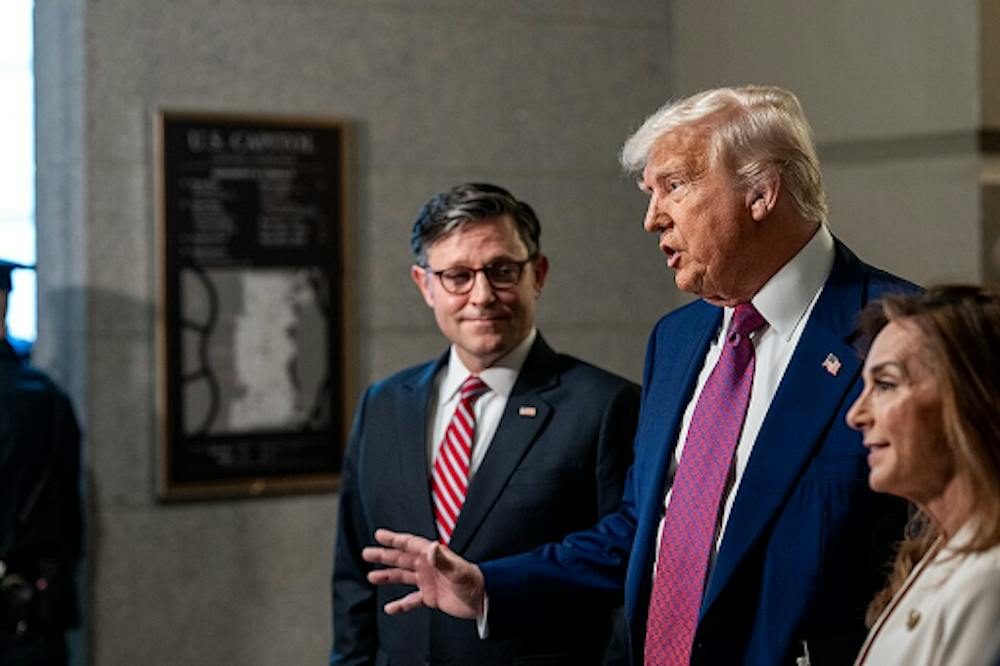
Conversely, The New York Times reported that Republican Speaker of the House Mike Johnson is staunchly opposed to hasty measures against AI.
“We’re not going to rush in and pass a piece of legislation that would do harm to the country and put China at an edge,” he told NBC in an interview. The Associated Press added that Johnson believes that national security could be threatened if China surpasses the United States’ level of AI development.
“I have concerns that if we don’t win AI, we’re going to be put in a very bad position,” President Trump told reporters on the tarmac in front of Air Force One, according to NBC News. “We are leading China right now by a pretty good period.”
Still, The Associated Press cited some other motives that the President may have to denounce AI limitations that are not entirely altruistic. Trump’s administration is counting on AI for growth in productivity and the AI industry’s recent evolution has accounted for most of the economic development during his second term.
Congress also has biases clouding its decisionmaking abilities beyond its usual gridlock.
“The House has just one week left on its calendar before November’s midterm elections,” according to The Hill. How representatives vote on AI could impact how their constituents vote in November, which could ultimately determine the political party that will control the House next year.
Additionally, ABC News noted that with the extremely limited voting time cited by The Hill, any bill on AI will be extremely difficult to pass without immediate bipartisan support and a superior level of efficiency than Congress has previously displayed.
Despite the confining appearance of the voting circumstances, The Associated Press counters that legislators across party lines are not giving up yet. Independent Senator Bernie Sanders will meet with other congress members for an AI briefing from developers and House Democrats have plans to meet privately to discuss the issue.
NBC also reported that “Rep. Ted Lieu, D-Calif., co-chair of the Democratic Commission on AI, has partnered with Rep. Nathaniel Moran, R-Texas, on what they’re calling the AI Kill Switch Act.”
Although these sudden bipartisan efforts are encouraging, The Associated Press noted that the paucity of leadership and unity displayed by the government has been a key point in many midterm campaign strategies already.
“What fills us with dread is the crushing weakness of our politics against the massive stakes of our times,” Democratic Senator Jon Ossoff of Georgia lamented at a reelection rally.